
UGC Usage Rights: A Complete Guide for Brands & Creators
UGC usage rights define how, where, and how long a brand can use creator content. See the standard terms, what to negotiate, and a sample rights agreement.
Table of Contents
UGC Usage Rights: A Complete Guide for Brands and Creators
“I paid for it, so I own it. Right?” Wrong.
“I created it, so I own it. Right?” Right… unless you explicitly sign those rights over to someone else.
Under U.S. copyright law, ownership vests in the creator the moment the work is made. No registration required, no contract needed. Usage rights exist to define when, how, and for how long a brand can use content that, by default, legally belongs to the creator.
Most paid partnerships between brands and creators get confusing when they lack clearly defined terms around content ownership and what the brand is actually allowed to do with delivered assets.
UGC usage rights are the contractual terms that clarify these questions for both brands and creators before they become problems.
If you're a brand scaling creator content for paid ads, or a creator building a sustainable freelance business, understanding how these rights work impacts you legally and financially. Creators can earn significantly more from a single piece of content when they know how to price usage, and brands can extract far more value when they know what rights to ask for.
This guide covers what UGC usage rights include, how they're typically structured, what they cost, and what both sides should watch out for before signing anything.
Why Securing and Specifying Usage Rights is Important
Vague creator agreements create legal risk and operational drag for marketing campaigns. When usage rights aren't defined upfront, brands spend time chasing creators for clarification mid-campaign.
A clause in your contract that says “brand may use content for marketing purposes” isn't specific enough. Which platforms? For how long? Can it be used in paid ads, or just organic? Every undefined variable becomes a conversation you'll have later, under worse conditions, usually after something has already gone wrong.
When rights are clearly scoped from the start, creators know exactly what they're licensing and can price accordingly. Brands know what they can do with the content without needing legal sign-off every time they want to repurpose an asset. And when a campaign performs well and the brand wants to extend usage or expand to new channels, there's already a framework for that conversation.
UGC platforms like SideShift that manage the full arc of a creator partnership, from brief, contract, and delivery to measurement, make this significantly easier for both creators and brands. Having usage rights built into the brief and agreement process means nothing gets assumed, nothing gets skipped, and both sides show up to the partnership knowing what they actually agreed to.
Types of UGC Usage Rights
The scope of what a brand can do with creator content depends on which rights are included in the agreement. Here are the most common categories:
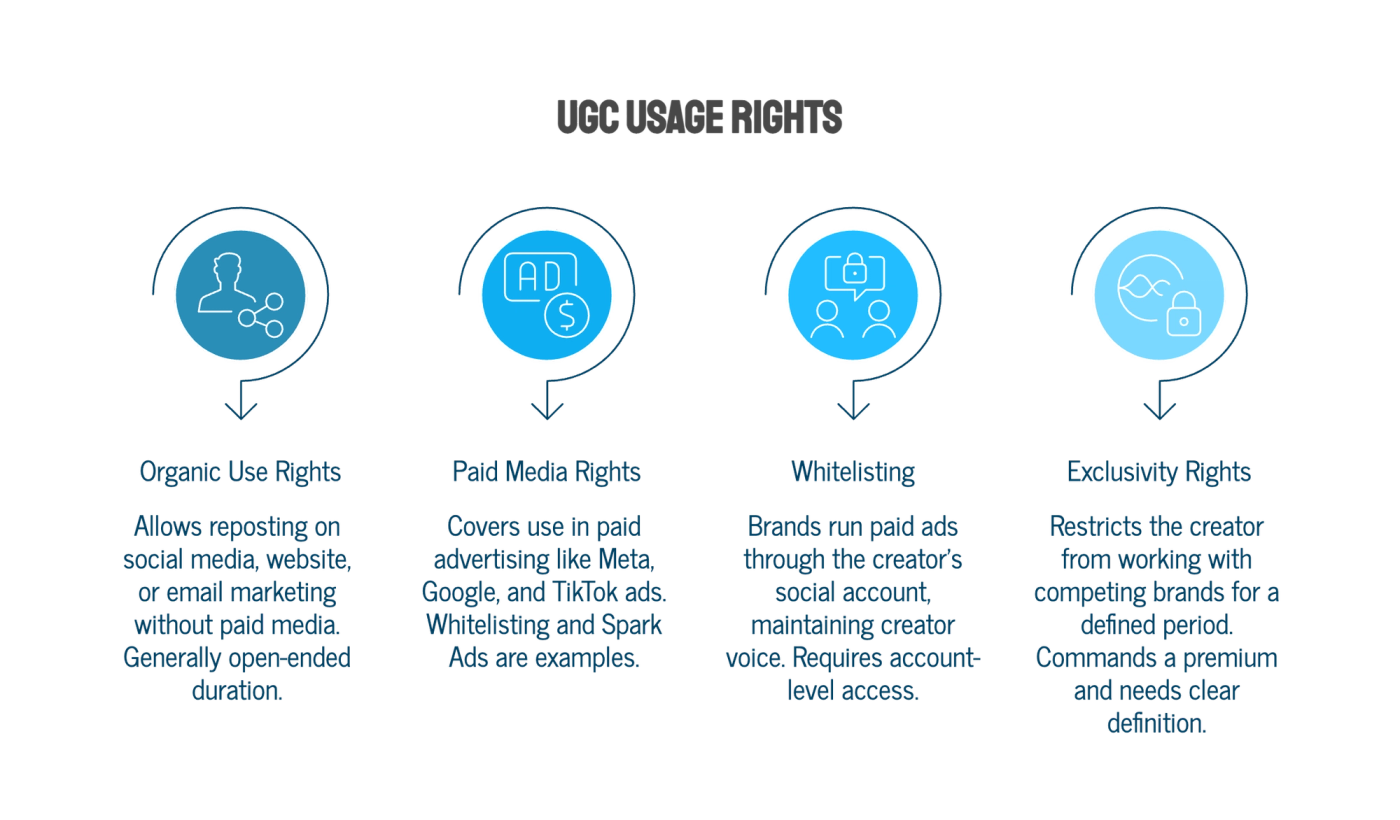
Organic use rights
Organic use rights allow a brand to repost or share the content on their own social media channels, website, or email marketing without running it as paid media. These rights are generally open-ended in terms of duration since the content sits on a platform rather than running on a paid schedule.
Want to put this into practice?
SideShift connects you with vetted UGC creators who actually deliver. Start your free trial and post your first job in under 10 minutes.
Paid media rights
Paid media rights cover the use of creator content in paid advertising, including Meta ads, Google display ads, TikTok ads, and similar channels. This is where whitelisting and Spark Ads come into play. Spark Ads, for example, let brands boost a creator's existing TikTok post as a paid ad directly from the creator's account. That requires explicit permission from the creator, and it's a separate rights category from simply reposting the content organically.
Whitelisting
Whitelisting rights give brands access to run paid ads through the creator's social account rather than the brand's own page. This format tends to perform well because it maintains the creator's voice and credibility in the ad unit itself. From a rights standpoint, whitelisting goes beyond just content use. It involves account-level access, so it needs to be clearly scoped and time-limited in any agreement.
Exclusivity rights
Exclusivity rights are separate from usage rights but are often bundled into the same agreement. These restrict the creator from working with competing brands for a defined period. Exclusivity commands a premium and should always have a clearly defined category (e.g., “direct competitors in the skincare space”), rather than a broad restriction.
Key Components of a UGC License
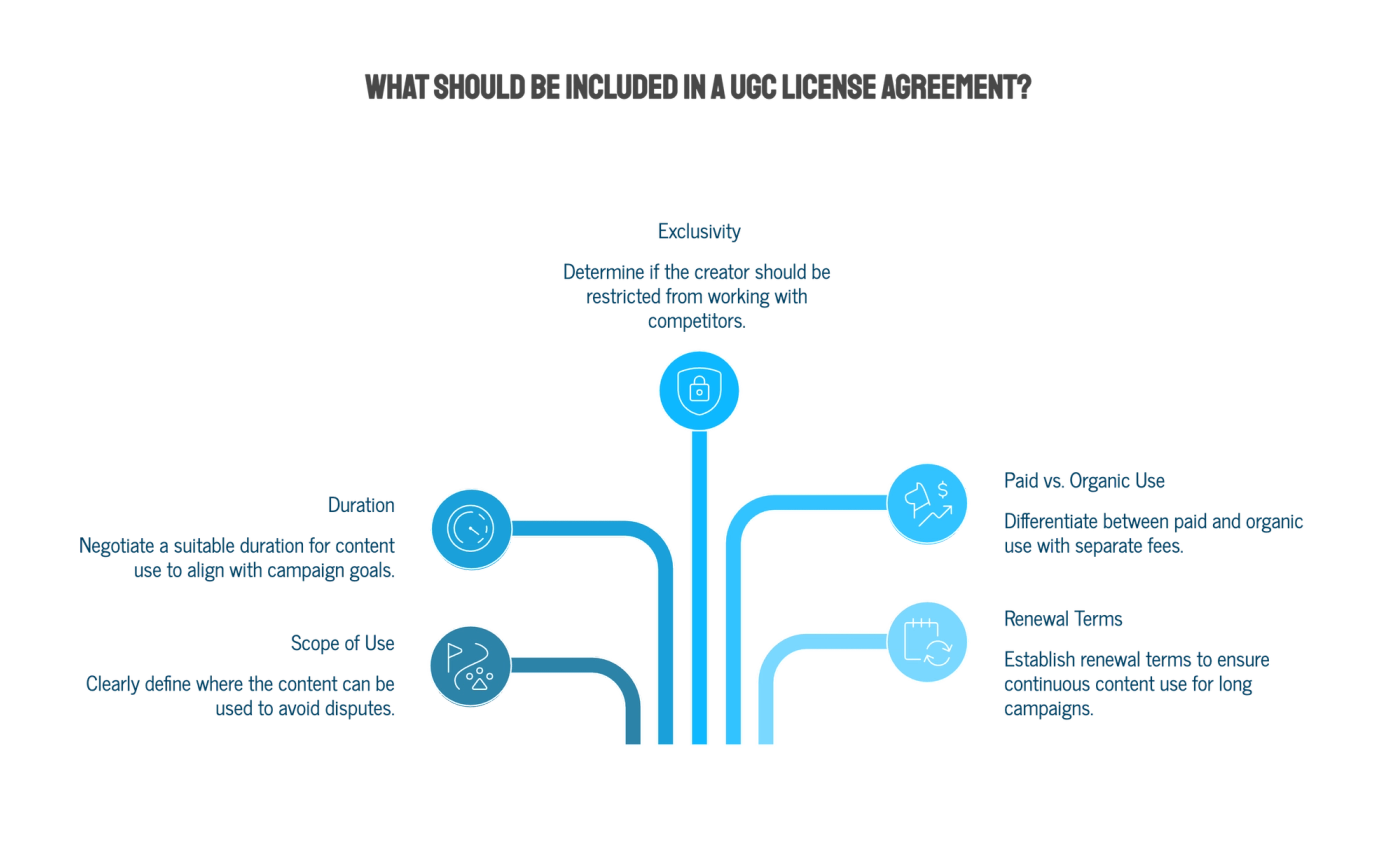
A solid UGC licensing agreement covers the following:
- Scope of use: Where exactly can the brand use the content? Social media, paid ads, retail, email, third-party syndication? Each channel should be named. Vague language like “digital use” creates room for disputes later.
- Duration: How long can the brand use the content? This is one of the most negotiated terms in creator contracts. A 30-day paid ads window is very different from a 12-month license or a perpetual license. Brands running evergreen campaigns naturally want longer windows. Creators may want to cap duration to preserve their ability to renegotiate rates.
- Exclusivity: Is the creator restricted from working with similar brands during or after the campaign? If yes, for how long and within what category?
- Paid vs. organic use: These should be treated as separate rights with separate fees. Organic reposting typically costs less than paid media licensing because the reach is more limited and controlled.
- Renewal terms: What happens when the license expires? Does it auto-renew? At what rate? This clause matters most for brands running content across long campaigns.
Paid vs. Organic Rights: What's the Real Difference?
Organic rights are lower risk for creators and lower cost for brands. The content lives on a social feed or website. If the brand-creator relationship sours, the brand takes it down. The financial upside for the creator is modest, and the exposure for the brand is relatively capped.
Paid media rights are a different story. When a brand runs a creator's video as a paid ad, they're putting money behind it to maximize reach. The content is being actively served to targeted audiences at scale, often over weeks or months. That's a meaningful commercial use, and it justifies higher licensing fees upfront.
Want to put this into practice?
SideShift connects you with vetted UGC creators who actually deliver. Start your free trial and post your first job in under 10 minutes.
Spark Ads specifically require that the creator's TikTok post remains live for the duration of the ad campaign, which means the brand is dependent on the creator's account health and behavior throughout that window. That dependency should also be reflected in the agreement.
An effective UGC strategy balances paid ugc with organic by structuring agreements that allow organic use also with a clear paid media upgrade path built in from the start.
Standard Industry Pricing for UGC Rights
There's no single pricing standard across the industry, but these ranges have become common benchmarks for how rights fees are structured as add-ons to a creator's base rate.
- Organic social use: 10-20% of base rate, typically covering a 3- to 12-month window
- Paid media use (Meta Ads/TikTok Spark Ads): 25-50% of base rate for a 30- to 90-day window
- Whitelisting: 30-50% of base rate for 30 to 60 days, reflecting the account-level access involved
- Exclusivity (by category): 20-50% of base rate, negotiated per month depending on how competitive the brand's space is
- Perpetual license: 100-200% of base rate with no expiration date
These are add-ons to the base creation fee. For example, a creator charging $500 for a video might add $150-$250 for 60-day paid media rights on top of that.
For brands that need evergreen content for product pages, pitch decks, or long-running ad sets, paying once for perpetual rights is a better investment than managing renewals every few months. Whether that structure makes sense for you depends on your campaign timeline. Short-term product launches don't need perpetual rights, but long-term brand assets usually do.
Best Practices for Brands
The brands that run into usage rights problems are usually the ones that figured out what they needed after the fact.
- Define rights before the brief goes out. If you know you're going to run paid ads with this content, include that in the project scope from the start. Trying to add paid media rights after delivery usually costs more and can create friction with the creator.
- Use written agreements. Verbal agreements don't hold up. Even for simple one-off projects, a short-form licensing agreement protects both parties. Platforms that handle this in the workflow, like SideShift, remove the administrative burden by building rights terms into the standard contract.
- Be specific about channels. “Digital rights” is not specific enough. Name the platforms. Name the ad formats. If you want to run Spark Ads or Partnership Ads, say so explicitly.
- Track license expiration dates. Running content past the agreed usage window is a common and avoidable mistake. If you manage high-volume creator programs, build expiration tracking into your content management workflow.
Best Practices for Creators
On the creator side, usage rights are less a legal formality and more of a pricing strategy that most creators underuse.
- Price organic and paid rights separately. You don't have to bundle everything. A brand asking to repost your content organically is a different request than a brand asking to run it as a whitelisted ad. Charge accordingly.
Want to put this into practice?
SideShift connects you with vetted UGC creators who actually deliver. Start your free trial and post your first job in under 10 minutes.
- Limit duration on paid media rights by default. Start with a 60- or 90-day window. If the brand wants longer, that's a renewal conversation with a new fee attached.
- Know what whitelisting and Spark Ads involve. Both require account-level access or specific technical permissions. Understand what you're agreeing to before granting it, and build in clear terms for revoking access when the campaign ends.
- Include a right to credit or attribution if that matters to you. Some brands run creator content without tagging the creator's account. If you want attribution, put it in the agreement.
Secure UGC Rights from Talented Creators Easily on SideShift
The bigger your creator program gets, the harder usage rights are to manage manually. Licenses expire while campaigns are still running. Creators are briefed without clear terms and push back on paid media use after the fact. Usage windows get missed because they're tracked in a spreadsheet someone last updated three months ago. At scale, those become recurring operational problems.
If you're sourcing UGC at volume, or building a creator program that needs to scale, SideShift gives you a cleaner, faster way to get from brief to licensed content.
FAQs
1. What are UGC usage rights?
UGC usage rights are the contractual terms that define how, where, and for how long a brand can use content created by a third party. They cover channels like paid ads, organic social, email, and websites, and they exist because creators retain copyright over their work by default.
2. Do you need a separate agreement for Spark Ads and Partnership Ads?
Yes. Both Spark Ads and Partnership Ads require explicit permission from the creator because they involve either boosting content from the creator's account or running ads in a co-branded format. These are platform-enforced requirements, not just best practices.
3. What's the difference between whitelisting and a standard paid media license?
A standard paid media license allows a brand to run the creator's content from the brand's own ad account. Whitelisting goes further and gives the brand access to run ads directly through the creator's social media account. Whitelisting typically commands a higher fee because it involves account access and the brand is leveraging the creator's identity in the ad.
4. How long should UGC usage rights last?
It depends on how you plan to use the content. For short-term campaigns, 30 to 90 days of paid media rights is a common standard. For evergreen content, product pages, or long-running brand assets, a perpetual license is more practical. On SideShift, perpetual rights are included by default to remove this friction entirely.
5. Can a creator revoke usage rights after granting them?
Generally, no. Once usage rights are granted through a written agreement, the creator cannot unilaterally revoke them for the duration specified in the contract. That said, terms like whitelisting access can be revoked outside of a contract if the brand violates platform policies or the creator's account is at risk. Clear termination clauses in the agreement protect both sides.