
TikTok Influencer Marketing: A Strategy Guide for Brands
TikTok influencer marketing rewards volume and authenticity over budget size. Here's how brands build creator campaigns that actually perform on TikTok.
Table of Contents
TikTok Influencer Marketing 101: Everything You Need to Know
TikTok influencer marketing has fundamentally changed what effective creator campaigns look like, and brands that treat it like a slightly faster version of Instagram are consistently leaving performance on the table. The platform's algorithm doesn't reward follower count the way legacy social media did. It rewards content quality, watch time, and resonance, which means a creator with 8,000 followers can outperform one with 800,000 if the content lands.
That shift has real strategic implications for how brands should be building creator campaigns. This guide covers everything marketing teams need to know about TikTok influencer marketing: how the platform works, how to source and structure creator partnerships, where UGC fits into the equation, and how to build a content system that compounds over time instead of burning budget on single posts that spike and disappear.
TikTok Broke the Old Influencer Marketing Model
On most platforms, reach is primarily a function of audience size. You hire a creator with a large following, their followers see the content, and reach scales with the follower count. TikTok breaks that model almost entirely. TikTok's For You Page algorithm distributes content based on performance signals, not subscriber relationships.
When a video gets uploaded, TikTok serves it to a small test audience and measures completion rate, replays, shares, comments, and likes. If those signals are strong, the content gets pushed to progressively larger audiences regardless of whether those viewers follow the creator.
A creator with 2,000 followers can generate a million views on a single video if the content performs. For brands, this has two major implications. First, follower count is a weak proxy for reach potential on TikTok. Second, content quality and format optimization matter far more than creator selection based on audience size.
The brands winning on TikTok right now are not the ones with the biggest influencer budgets. They're the ones producing the most content variations and finding what the algorithm responds to fastest. This is why high-volume UGC strategies, where multiple creators produce multiple content formats simultaneously, outperform single-creator partnerships on TikTok more consistently than on any other platform.
Different Types of TikTok Influencers
TikTok's creator ecosystem is large, fast-moving, and more accessible for brands than most marketing teams realize. Understanding the different creator categories helps you allocate budget and set realistic expectations.
Nano Creators (1K-10K followers)
Small following, often high engagement rates, and content that feels genuinely personal and unpolished. On TikTok more than anywhere else, these creators can punch above their weight because the algorithm doesn't cap their distribution. Ideal for UGC campaigns where content quality and authenticity matter more than guaranteed reach.
Micro Creators (10K-100K followers)
The most versatile tier for brand campaigns. They've built enough of an audience to demonstrate content resonance, they're still accessible and affordable, and their content typically feels native to the platform rather than performative. Engagement rates at this tier tend to be significantly higher than macro-level creators.
Macro and Mega Creators (100K-1M+ followers)
High awareness potential and established production quality, but the economics shift considerably. Cost per post rises sharply, content often feels more produced and less native, and engagement rates typically compress as audience size grows. Best suited for awareness campaigns where scale of impression matters more than conversion efficiency.
Want to put this into practice?
SideShift connects you with vetted UGC creators who actually deliver. Start your free trial and post your first job in under 10 minutes.
UGC Creators (Follower count is irrelevant)
This category has exploded on TikTok specifically because the platform has demonstrated that creator-style content outperforms traditional ad creative in paid campaigns. UGC creators produce short-form video assets for brands to own and run through TikTok's ad system. Their personal following doesn't factor into the value exchange. Content quality, delivery, and format alignment do.
How to Build a TikTok Influencer Campaign Step by Step
If you're working out how to start influencer marketing on TikTok, the good news is that the platform rewards volume and authenticity over polish and production value, which means the barrier to entry is lower than most brands expect. The steps below lay out the process in the order that actually works.
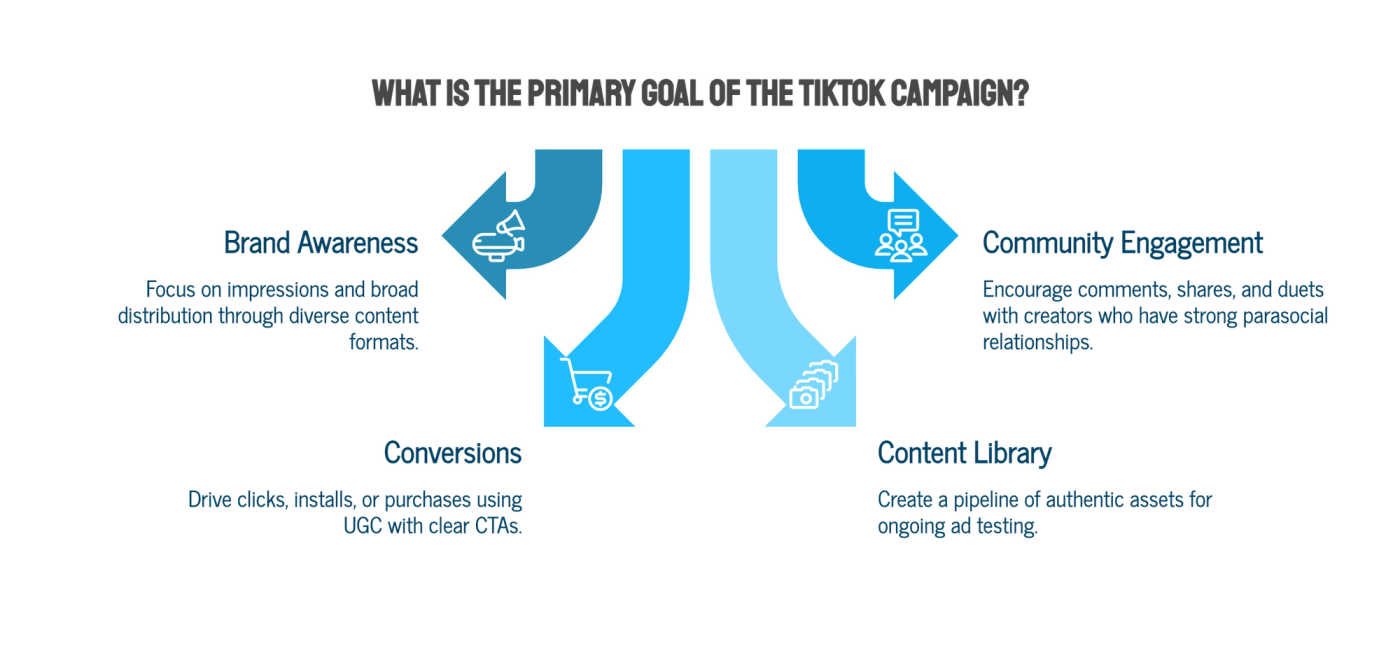
Step 1: Define the Outcome Before You Cast Anyone
TikTok campaigns fail most often not because of creator selection, but because the goal was never specific enough to optimize toward. Get the business objective locked before anything else.
- Brand awareness and reach: You want impressions and broad distribution. Volume of content and format diversity are your primary tools.
- Community and engagement: You want comments, shares, and duets. Creators with strong parasocial relationships and conversational content styles perform here.
- Conversions and direct response: You want clicks, installs, sign-ups, or purchases. UGC content running through TikTok Spark Ads or standard paid campaigns with clear CTAs is consistently your highest-leverage option.
- Content library for paid: You need a pipeline of authentic short-form assets for ongoing ad creative testing. High-volume UGC is the answer.
Step 2: Understand TikTok's Content Requirements
TikTok is not a platform where repurposed content from other channels performs well. Content needs to feel native to succeed, which means understanding the platform's specific creative norms before you brief any creator.
TikTok rewards:
- Hooks in the first 1 to 2 seconds that create immediate curiosity or pattern interruption
- Vertical 9:16 video shot on mobile, not studio-produced content
- Conversational, direct-to-camera delivery that mimics how actual users talk on the platform
- Trending sounds and audio formats when they're contextually relevant
- Content that earns replays, whether through information density, humor, or emotional resonance
TikTok punishes:
- Horizontal video or content that's clearly been repurposed from another format
- Overly produced creative that reads as an advertisement
- Slow intros without a compelling opening hook
- Mismatched audio that doesn't fit the content tone
Step 3: Source Creators Who Understand the Platform Natively
Finding TikTok influencers for your brand requires a different evaluation framework than other platforms. The skills that make a creator effective on TikTok are not the same ones that built their following elsewhere.
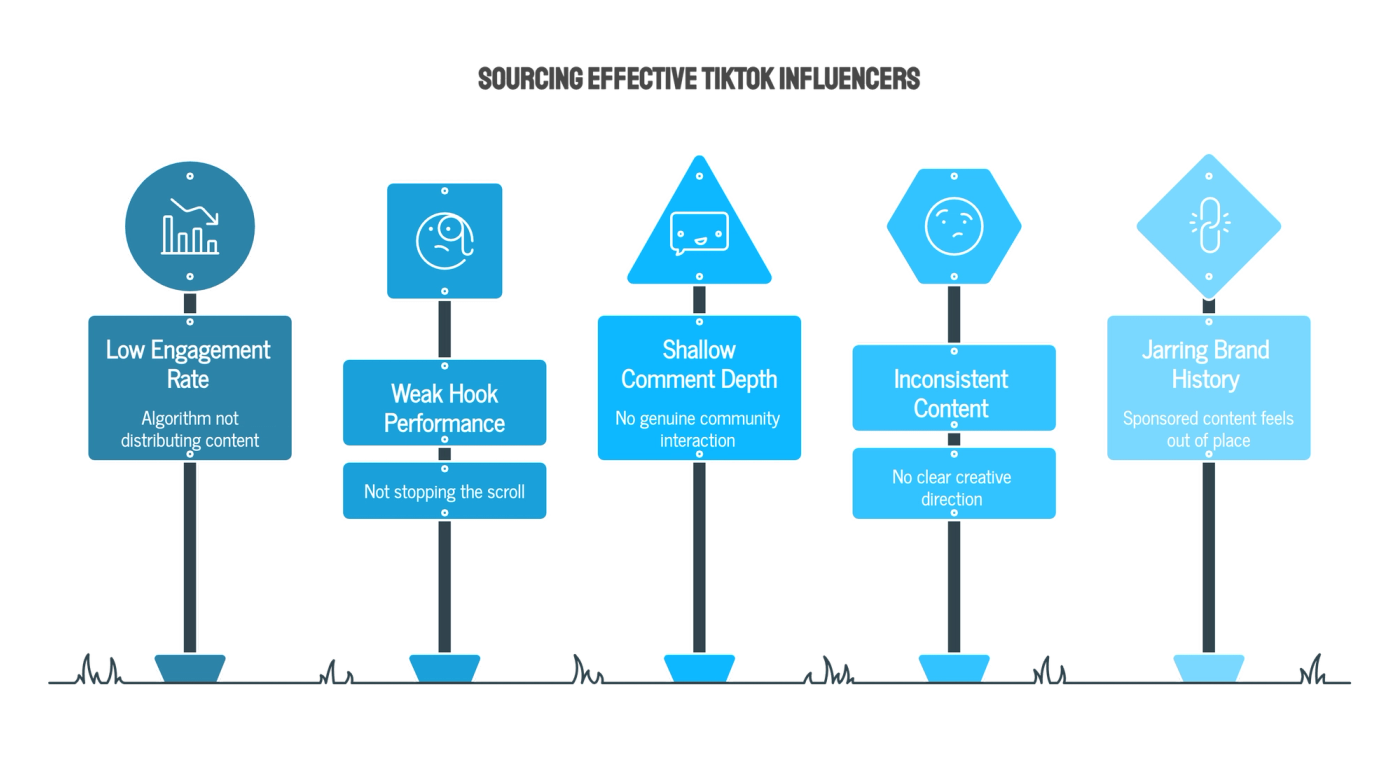
When sourcing TikTok creators, evaluate:
- TikTok-specific engagement rate: Look at average views relative to follower count. On TikTok, a view-to-follower ratio above 10% generally indicates content that the algorithm is picking up and distributing.
Want to put this into practice?
SideShift connects you with vetted UGC creators who actually deliver. Start your free trial and post your first job in under 10 minutes.
- Hook performance: Watch the first 3 seconds of their recent videos. Are they stopping the scroll? Do they create immediate curiosity?
- Comment depth: Surface comments like “lol” or emoji reactions are weak signals. Comments that continue the conversation or tag friends signal genuine community.
- Content consistency: Does the creator have a recognizable style and format, or are they randomly experimenting without a clear creative direction?
- Brand collaboration history: Have they done sponsored content before? Does it feel integrated or jarring?
For brands just getting started, TikTok's own Creator Marketplace is a reasonable first stop. It gives access to creator profiles, audience demographics, and basic performance data without any third-party setup. However, the marketplace skews toward larger creators, filtering options are relatively basic, and it doesn't help with contracting, content approvals, or payments. It works for a one-off partnership, but it doesn't scale.
For sourcing at volume or for brands that want an end-to-end workflow rather than just a directory, Creator marketplaces like SideShift solve this by giving brands access to a pre-vetted network of creators with built-in recruitment, contracting, and payment tools, so sourcing doesn't become a full-time job.
Step 4: Write a Brief That Lets the Creator Be a Creator
TikTok is the platform where brand over-control does the most damage. Content that follows a rigid corporate script will not perform, and experienced creators know it. The brief needs to protect your brand requirements while giving creators enough room to make something that actually works on the platform.
A strong TikTok creator brief covers:
- Product context and key benefit: Explain the main problem your product solves simply enough that the creator can communicate it naturally.
- Non-negotiables: Outline any brand safety requirements, prohibited claims, or mandatory messaging that must be included.
- Format guidance: Recommend video length (15-45 seconds for most campaigns), whether a specific CTA needs to be stated, and any required visual elements (showing the product, demonstrating use, etc.).
- Creative latitude statement: Explicitly tell the creator that you want their authentic voice and their approach to making it work for their audience. Empower the creators to add their own flair. You don’t want to overscript.
- Usage rights: Be explicit about whether you're licensing content for paid ads, whitelisting, or both. TikTok Spark Ads require specific creator authorization, so this needs to be settled in the agreement.
Step 5: Amplify Through Spark Ads and Paid Ads
Organic creator content on TikTok has real reach potential, but the brands building durable performance engines are combining organic posting with paid amplification. TikTok's Spark Ads format allows brands to boost existing organic creator posts as paid content, keeping the native look and feel intact while adding precise audience targeting and guaranteed distribution.
The performance advantage of Spark Ads over standard paid creative is well-documented within TikTok's ecosystem. Content that's already demonstrated organic engagement signals quality to the algorithm, and that quality signal carries into paid distribution. Running UGC content through Spark Ads is one of the most efficient formats available on the platform for direct response goals.
Want to put this into practice?
SideShift connects you with vetted UGC creators who actually deliver. Start your free trial and post your first job in under 10 minutes.
Why High-Volume UGC Outperforms the Single-Influencer Model on TikTok
TikTok's algorithm is essentially a content testing machine. It surfaces what resonates and buries what doesn't, continuously and at scale. The brands that treat TikTok influencer marketing as a single-post strategy are working against the platform's fundamental logic.
The high-volume UGC approach aligns directly with how TikTok actually works. Instead of one creator posting one piece of content and hoping it hits, you deploy 10 to 50 creators posting multiple content variations across different hooks, formats, and angles. Some will underperform. Some will break through. The data from what performs tells you exactly what to scale, what to push through paid amplification, and what to iterate on in the next production cycle.
Photogeniq is a clean illustration of this in practice. The AI photo-generation app had under 1,000 users and no content engine when they came to SideShift.
Rather than betting on a single high-profile creator, the campaign launched 100+ TikToks in 30 days across formats like glow-up challenges, celebrity lookalikes, and friend transformations, paired with daily feedback loops to identify what was gaining traction and iterate fast.
The formats that resonated got more resources, the ones that didn’t got cut. In one month, the campaign drove 69M+ organic views, 100x user growth, and a major spike in paid conversions at a CPM of $0.10.
That last number is worth sitting with. The efficiency was the result of volume, iteration, and letting the algorithm surface what worked.
This is what it means to find Content Market Fit: the process of testing enough content variations fast enough to identify what your audience actually responds to, then systematically doubling down on it. The brands that win on TikTok are the ones with the best process for producing, testing, and iterating at volume.
Build Your TikTok Influencer Marketing Strategy with SideShift
TikTok rewards brands that move fast, test constantly, and build content systems rather than one-off campaigns. Doing that manually, sourcing creators, negotiating terms, managing contracts, processing payments, tracking performance, is operationally intensive in a way that doesn't scale.
With access to 800,000+ U.S.-based Gen Z creators, SideShift gives marketing teams the infrastructure to run high-volume TikTok creator campaigns without the overhead. Post a job, recruit from a pre-vetted talent pool, manage contracts and payouts in one place, and use performance analytics to identify what's working and scale it. Plans start at $199/month for brands ready to move from sporadic creator outreach to a real content operation.
TikTok's algorithm will keep rewarding authentic, high-volume creator content. The brands building that capability now are the ones who will be hardest to compete with in 12 months.
FAQs
1. How important is follower count when choosing TikTok influencers for a brand campaign?
On TikTok, follower count matters less than on any other major platform. The algorithm distributes content based on performance signals, not audience size, which means a creator with 5,000 followers can reach more people than one with 500,000 if their content resonates. Brands should prioritize a creator's average view rate, hook quality, and engagement depth over raw follower numbers when evaluating TikTok partnerships.
Want to put this into practice?
SideShift connects you with vetted UGC creators who actually deliver. Start your free trial and post your first job in under 10 minutes.
2. What is the difference between TikTok Spark Ads and standard TikTok paid ads?
Spark Ads allow brands to amplify existing organic TikTok posts, either from the brand's own account or from a creator's account with their authorization. This keeps the content looking native and retains the social proof of organic engagement. Standard in-feed ads are created separately and look more like traditional paid creative. Spark Ads consistently outperform standard formats for direct response goals because the content reads as organic rather than as an advertisement.
3. How much does TikTok influencer marketing cost for brands?
Costs vary significantly by creator tier. Nano and micro creators typically charge $100-$1,500 per post, while macro creators can range from $5,000 to $25,000+. UGC creator content produced for brand-owned paid campaigns typically runs $100-$500 per video asset. For brands running high-volume campaigns, SideShift's plans start at $199/month and provide the infrastructure to manage large creator rosters without proportional increases in operational overhead.
4. How many TikTok creators should a brand work with simultaneously?
More than most brands expect. Because TikTok's performance is content-driven rather than audience-driven, the goal is to generate enough content variations to find what the algorithm rewards. Brands running effective TikTok UGC campaigns typically work with anywhere from ten to one hundred creators simultaneously, testing different hooks, formats, and messaging angles. Starting with five to ten creators is reasonable for a brand new to the platform, with the explicit plan to scale what performs.
5. How do you measure the ROI of a TikTok influencer marketing campaign?
Align your metrics to your campaign objective. For awareness, track video views, completion rate, and reach. For engagement, track comments, shares, and saves. For conversion campaigns, track link clicks, promo code usage, and cost per acquisition through TikTok Ads Manager. If you're running UGC content through paid, monitor cost per click and creative-level performance data to identify which content variations are driving results. The goal is to build enough data to know what to scale, not just to report on what happened.