
How to Start an Influencer Agency in 2026
Brands are spending more on creator marketing than ever, and agencies are capturing that budget. Here's how to build one that stands out and scales.
Table of Contents
How to Start an Influencer Agency in 2026
More brands are investing in the creator ecosystem, and more influencers and creators are looking for brand partnerships. In 2026, 87.49% of brands expect their influencer marketing budgets to increase, showing just how quickly the industry continues to grow. What was once considered an experimental marketing channel is now a core part of many companies’ advertising strategies. Businesses of all sizes, from startups to enterprise brands, are investing in creators because consumers increasingly trust people more than traditional ads.
At the same time, creators need help managing outreach, negotiations, campaign logistics, content approvals, and long-term partnerships. That gap between brands and talent is exactly where influencer agencies come in. Agencies are no longer just talent managers for celebrities or massive influencers. Many successful modern agencies specialize in niche creators, UGC campaigns, affiliate partnerships, TikTok creators, or local micro-influencer activations.
This guide walks through exactly how to start an influencer agency in 2026, from picking your model and landing your first clients to building the operational infrastructure that lets you actually scale.
What Is an Influencer Agency—and What Isn’t It?
An influencer agency acts as the bridge between brands and creators. Depending on the business model, agencies help companies source influencers, manage campaigns, negotiate contracts, coordinate deliverables, track performance, and build long-term creator partnerships. Some agencies also represent creators directly, helping influencers secure brand deals, manage communication, and grow their careers.
An influencer agency is part marketing partner, part relationship manager, and part operations team. The job is helping brands run campaigns that actually perform while making the process easier for everyone involved.
An influencer agency isn’t simply reposting influencer emails or acting as a middleman with no strategy. Successful agencies understand content, audience fit, platform trends, campaign goals, usage rights, timelines, analytics, and creator relationships. They know how to pair the right creators with the right brands and how to structure and match campaigns that feel authentic instead of forced.
It’s also important to understand that not all influencer agencies are the same. Some focus exclusively on influencer campaigns that leverage creators’ audiences and reach, while others specialize in UGC creators who produce content without posting it to their own followers. Some agencies operate as talent management companies representing creators, while others function more like creative or marketing agencies that offer influencer campaigns as a service.
In 2026, the industry is broadening quickly. Many modern agencies now combine influencer marketing, UGC production, paid social creative, affiliate marketing, and creator sourcing into a single service offering because brands want creator content that can work across multiple channels.
What Kind of Influencer Agency Do You Actually Want to Build?
Before you register an LLC or pitch your first client, you need to get specific about your business model. “Influencer agency” covers a wide range of operations, and the ones that struggle most are usually the ones that never defined what they were.
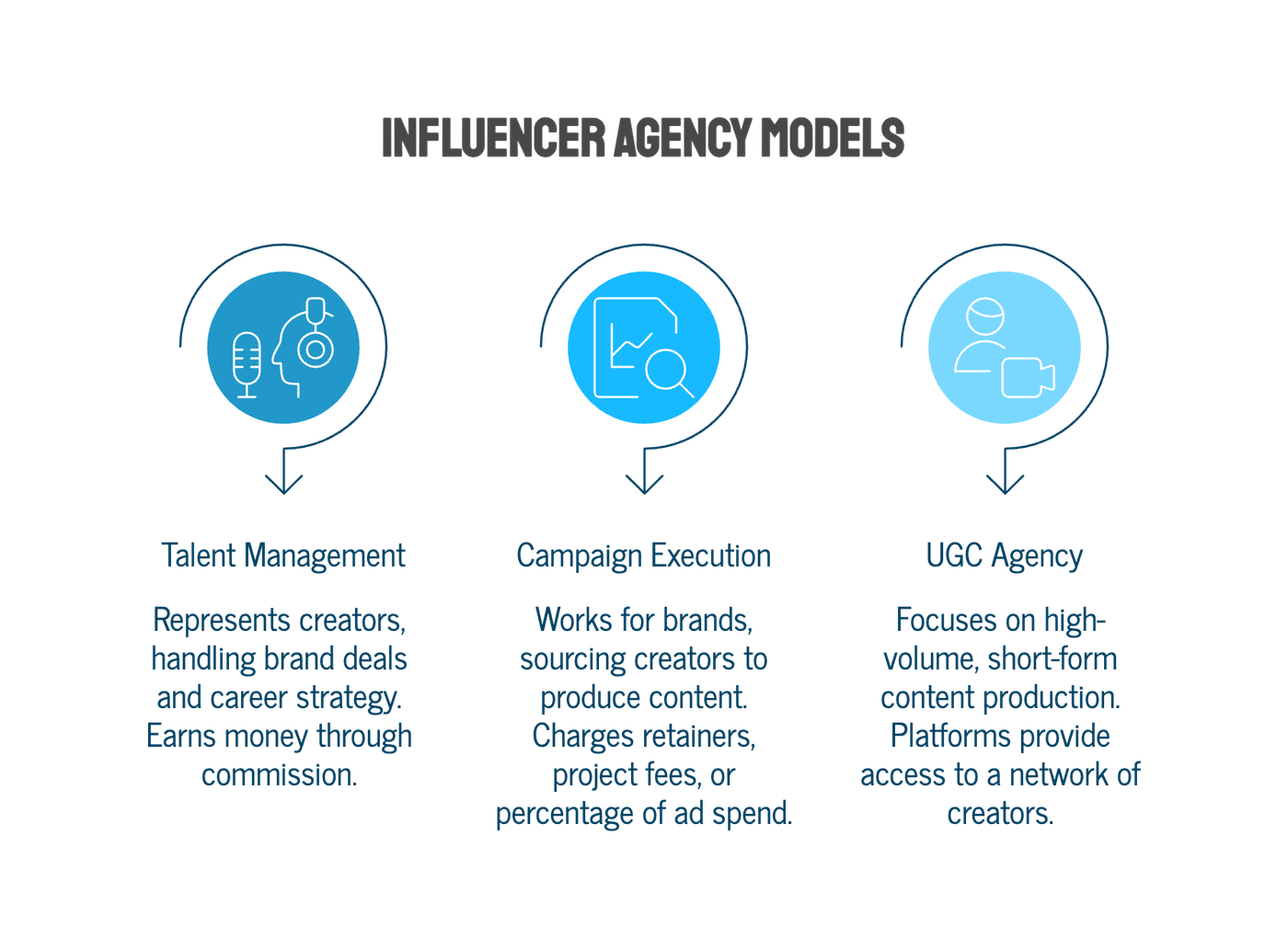
The two most common models are talent management and campaign execution. Talent management agencies represent creators directly, handling brand deals, contract negotiation, and career strategy on their behalf. They make money through commission, typically 10-20% of what their talent earns. Campaign execution agencies, on the other hand, work for brands, sourcing and managing creators to produce content that hits specific performance goals. They charge retainers, project fees, or a percentage of ad spend.
Want to put this into practice?
SideShift connects you with vetted UGC creators who actually deliver. Start your free trial and post your first job in under 10 minutes.
A third model that's grown significantly in the last two years is the UGC agency, which sits closer to the campaign execution side but focuses specifically on high-volume, short-form content production rather than influencer reach. This is where platforms like SideShift have changed the math considerably, giving agencies access to a network of 800,000+ creators without the manual sourcing grind.
Picking a model isn't a philosophical exercise, but it will determine your pricing structure, your contracts, your team, and who you spend most of your day talking to. Know which one you're building before you do anything else.
Choosing a Niche That Actually Wins Business
In 2026, the influencer marketing space is crowded enough that saying “we do creator campaigns for everyone” is no longer a differentiator. It’s actually a red flag to potential clients who want to see that you understand their category deeply.
Instead of trying to serve every industry, it’s far more effective to go deep in one or two niche markets and build authority within those spaces first before expanding. Specialization signals expertise, and in a competitive landscape, expertise is what wins trust and closes deals.
This is also where you get to be more intentional about the kind of business you want to build. Your niche shouldn’t only be based on what looks profitable on paper, it should also reflect your interests, strengths, and long-term energy. What work won’t you get tired of doing? What types of brands and creators do you actually enjoy working with day to day? What excites you enough to stay consistent when things get repetitive?
The strongest agencies are often built at the intersection of demand and genuine interest. Build there first, and expansion becomes a natural next step rather than a forced strategy decision.
The strongest niches tend to be ones where you have genuine domain fluency. If you spent three years doing growth marketing for SaaS companies, that's your niche. If you built a following in fitness before transitioning to the business side, health and wellness brands will trust you faster than they'd trust a generalist who just learned what macros are.
Some verticals worth considering are:
- B2B SaaS and tech tools, where founders are realizing organic creator content outperforms LinkedIn ads for developer and SMB audiences
- Health, wellness, and CPG, where UGC-style content consistently outperforms polished brand creative on TikTok and Instagram Reels
- Finance and fintech, a regulated space that still needs education-first creator content and is willing to pay well for agencies that understand compliance
- Gaming and entertainment, where creator affinity with audiences is often stronger than any other vertical
Want to put this into practice?
SideShift connects you with vetted UGC creators who actually deliver. Start your free trial and post your first job in under 10 minutes.
How to Structure Your Services and Pricing
One of the most common mistakes new agencies make is underpricing to win clients and then burning out trying to deliver. Your pricing needs to account for the actual time, tools, and coordination costs of running a campaign, not just the hours you're visible on a call. Pricing model and service scope are two sides of the same decision.
Typical Agency Pricing Model
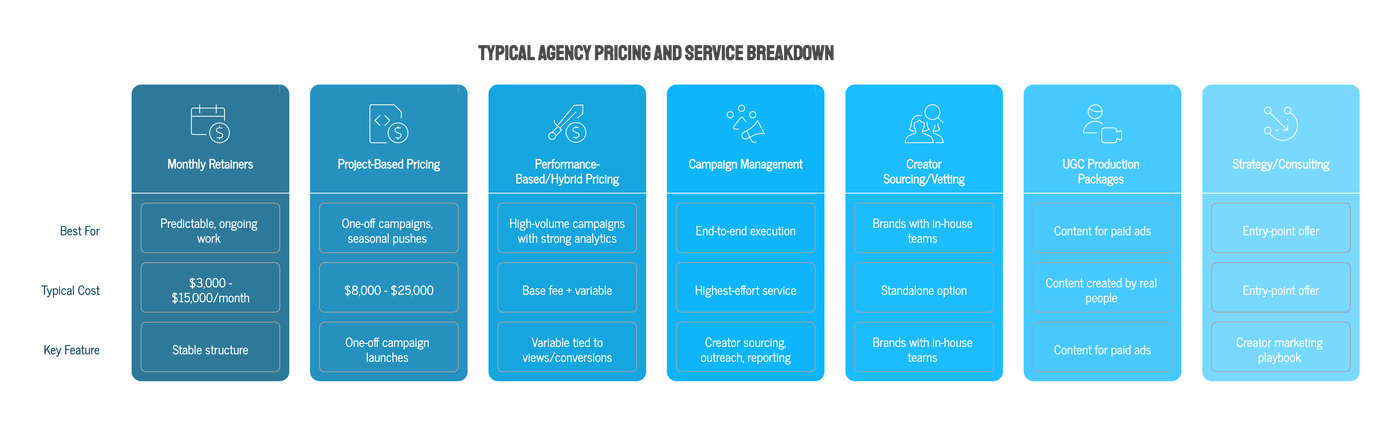
- Monthly retainers are the most stable structure and the most attractive to clients who want predictability. For campaign management, retainers in 2026 typically range from $3,000 to $15,000 per month depending on scope, number of creators, and deliverables.
- Project-based pricing works well for one-off campaign launches, seasonal pushes, or brands that aren't ready to commit to ongoing work. A typical product launch campaign involving 20-40 creators might run $8,000 to $25,000 all-in.
- Performance-based or hybrid pricing is gaining traction, especially in the UGC space. Clients pay a base fee plus a variable tied to views, conversions, or content volume. This structure works in your favor if you're running high-volume campaigns with strong analytics because the upside is real.
Typical Influencer Agency Service Breakdown
- Campaign management is end-to-end execution covering creator sourcing, outreach, contract negotiation, content approvals, and post-campaign reporting. This is the highest-effort service and should be priced accordingly.
- Creator sourcing and vetting can be a standalone option for brands with in-house teams that lack the relationships or tools to find the right creators at scale.
- UGC production packages provide content created by real people for use in paid ads, landing pages, and organic brand channels, independent of the creator's own audience distribution.
- Strategy and consulting serve as an entry-point offer for brands that are not ready for a full campaign but need a creator marketing playbook, channel guidance, or an audit of past influencer spend.
Build Your Operational Stack
Running a creator campaign manually, meaning cold DMs, spreadsheets, Venmo payments, and PDF reports, is fine for one client. It falls apart at three. If you're building an agency with the intention of scaling, your operational infrastructure needs to be in place before you need it.
The Core Tools You'll Need
The tools you choose early when starting a creator marketing agency sets the ceiling for how many clients you can realistically serve without things falling apart.
- Creator sourcing and management: This is where most agency ops break down. Finding creators manually is slow and inconsistent. A platform like SideShift lets you post a campaign brief and have qualified applicants come to you, with the ability to filter by platform, niche, and audience profile. At 800,000+ creators already on the platform, the sourcing problem essentially goes away.
- Contracts and deliverables tracking: Every creator engagement needs a contract, even for small campaigns. Tools that handle this in-platform save hours per campaign and reduce the legal exposure that comes with informal agreements.
- Payments: As your creator roster grows, manual payments become a serious operational liability. Batch payout systems with automated tax documentation (W9s, 1099s) are a convenience and a compliance necessity at any meaningful volume.
Want to put this into practice?
SideShift connects you with vetted UGC creators who actually deliver. Start your free trial and post your first job in under 10 minutes.
- Reporting: Clients need to see results. Real-time dashboards that give clients direct visibility into campaign performance reduce the back-and-forth and, more importantly, reduce churn. When a client can log in and see that their campaign generated 2.4 million views last week, they don't need to wait for your monthly PDF to stay bought in.
The agencies that scale are the ones that treat operational infrastructure as a competitive advantage and invest in it from the start. SideShift's agency tier is built specifically for centralizing sourcing, management, payments, and reporting across multiple clients in one place, which means you can add clients without adding headcount at the same rate.
Land Your First Clients
The first three clients are the hardest. Not because the work is harder, but because you're selling on potential rather than proof.
1. Start in your network. The first client for most successful agencies wasn't found through cold outreach. It was a founder they already knew, a former employer, or a brand they had a genuine connection to. These relationships move faster and are more forgiving of the early-stage roughness that comes with any new operation.
2. Build a spec campaign. If you don't have client work or a portfolio ready to show, create a mock campaign for a brand you'd want to work with. Choose a real brand, define a realistic brief, source a few creators through SideShift, produce the content, and document the results. This is your case study. It demonstrates process, taste, and execution ability before you've had a paying client.
3. Be specific in your outreach. “We help brands grow with influencer marketing” gets ignored. “We run UGC campaigns for DTC health brands and deliver 3x the content volume at half the cost of traditional influencer approaches” gets a meeting. Lead with the outcome, not the service description.
4. Focus on retention from day one. It’s easier to keep a client or creator engaged than it is to constantly replace them, and retention is what actually builds predictable, scalable revenue.
Scale Your Influencer Agency With SideShift
The opportunity is real, but the gap between a freelance operation and a scalable business will always come down to infrastructure. If you're wondering how to build an influencer agency that scales, the ones winning right now are connecting creative campaigns while building repeatable systems early on, including consistent creator sourcing, clean payout workflows, and reporting that keeps clients confident between calls.
SideShift was built for exactly this. Agencies on the platform run multi-client campaigns from one dashboard, pay out hundreds of creators without manual coordination, and give clients real-time visibility into results without building a single spreadsheet. Both plans include a 7-day free trial at no cost, so you can see the full operation before your first client call. If you're not sure which plan fits your volume, a free 15-minute strategy call covers your options, walks you through the Agency Dashboard, and helps you figure out the right setup for where your agency is headed.
Want to put this into practice?
SideShift connects you with vetted UGC creators who actually deliver. Start your free trial and post your first job in under 10 minutes.
FAQs
1. How much does it cost to start an influencer agency?
The startup costs are pretty lean compared to most other service businesses. You'll need basic legal setup (LLC formation runs $50 to $800+ depending on your state), a contract template, and ideally a CPA and business attorney to help structure things correctly from the start. Add in a creator management platform to help you scale with influencer management and it's possible to launch for under $10,000 in hard costs. The real investment is time, specifically the time it takes to land your first two or three clients.
2. Do you need a large creator network before launching?
No. Most successful agencies don't build proprietary creator networks from scratch. They use platforms like SideShift that already have hundreds of thousands of vetted creators ready to apply to campaigns, which means you can start delivering for clients immediately without years of relationship-building.
3. What's the difference between an influencer agency and a UGC agency?
An influencer agency typically focuses on reach, placing brands with creators who have established audiences. A UGC agency focuses on content production at volume, sourcing creators to produce authentic content regardless of follower count. UGC agencies tend to be more scalable because the content can be repurposed across paid and organic channels and the creator pool is much larger.
4. How do influencer agencies make money?
The most common models are monthly retainers charged to brand clients, project-based fees for specific campaigns, commission on creator deals (more common in talent management), and hybrid pricing that includes a base fee plus performance bonuses. Most agencies running volume UGC campaigns use retainers as their primary revenue model.
5. How many clients can one person manage at an influencer agency?
With manual processes, one person can realistically handle two to three clients before quality degrades. With the right platform infrastructure handling creator sourcing, contracts, payments, and reporting, a solo operator or small team can manage eight to twelve clients simultaneously without the work scaling linearly with headcount.