
How to Build an Influencer Marketing Strategy
A strong influencer marketing strategy balances reach, content volume, and ROI. Here's how to build one that actually performs across platforms and scales.
Table of Contents
How to Build an Influencer Marketing Strategy for Your Business
Influencer marketing is what happens when brands partner with creators to reach audiences through content those audiences already trust. Done well, it's one of the more efficient channels available.
Brands are averaging around $5.78 in revenue for every $1 spent in influencer marketing, and a survey of over 1,000 U.S. consumers found that 81% have either researched, purchased, or considered a product or service after seeing friends, family, or influencers post about it. Without a strategy, though, those numbers don't materialize.
This guide walks through how to build an influencer marketing strategy that performs, with clear goals, the right creator mix, a content framework that scales, and measurement that tells you something useful.
Start With Goals That Are Specific Enough to Measure
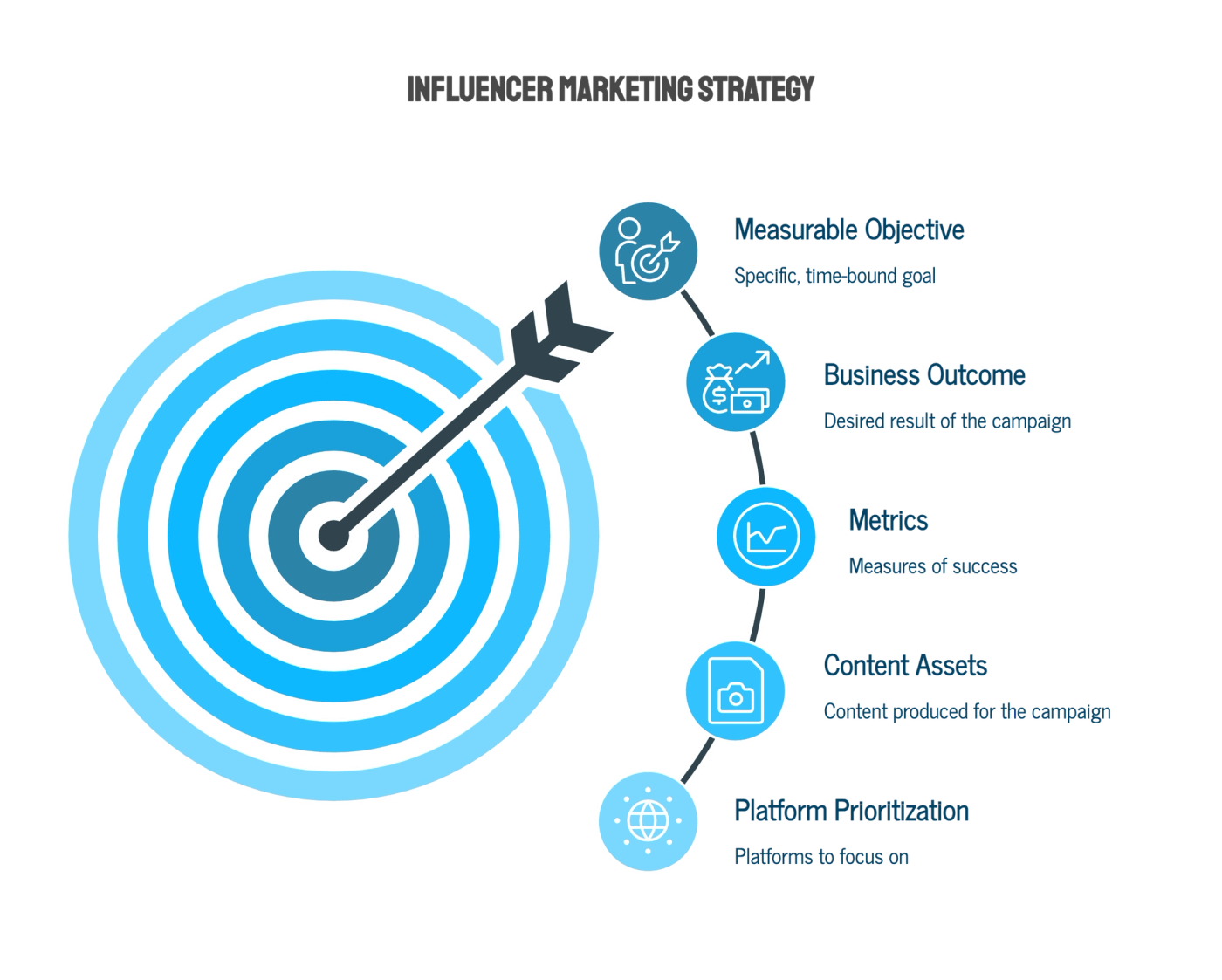
The first thing that separates a real influencer marketing strategy from a guess is a defined objective. “More brand awareness” is not an objective. It's a direction. A real objective is measurable, time-bound, and tied to a business outcome.
Before you book a single creator, answer these questions:
- Are you trying to drive top-of-funnel awareness, bottom-of-funnel conversions, or both?
- What does success look like in 30, 60, and 90 days?
- What metric are you willing to optimize against: impressions, engagement rate, click-through rate, cost per acquisition, or return on ad spend?
- Is this campaign meant to produce owned content assets, third-party distribution, or both?
The answers shape every other decision, including which platforms to prioritize, what type of creators to work with, and how much content volume you actually need.
A brand launching a new product needs different tactics than one retargeting warm audiences or driving repeat purchases. Conflating those goals at the start is one of the most common reasons influencer campaigns underdeliver.
Astra, a social self-growth app, is a good example of what goal clarity looks like in practice. Instead of chasing broad reach, they came in with a specific objective to drive installs and build recurring engagement with a Gen Z audience. That focus shaped creator selection, content formats (compatibility skits, friendship tests, emotionally resonant short-form), and the volume strategy. SideShift ran 400+ TikToks over six weeks with daily feedback loops, optimizing each iteration for installs rather than views alone.
The results reflected the goal: 5M+ organic views, 25K+ downloads from a single video, and a UGC bank that continued performing in paid ads long after the campaign ended.
When your objective is defined upfront, the content you produce tends to have a longer shelf life because it was built to convert.
Define Your Audience Before You Define Your Creator Criteria
A mistake brands make early in strategy development is leading with the creator search before they've locked in their audience profile. Build the audience profile first, then work backward to find creators whose followers match.
Build an audience profile that includes:
- Age range and generation (Gen Z, Millennial, etc.)
- Key platforms they spend the most time on
- Content formats they engage with (short-form video, long-form review, tutorial, lifestyle)
Want to put this into practice?
SideShift connects you with vetted UGC creators who actually deliver. Start your free trial and post your first job in under 10 minutes.
- What problems or interests they have that your product addresses
- What language and tone resonates with them
This exercise directly informs your creator brief. If your audience is 18 to 24-year-old women interested in wellness, you're not just looking for creators in that niche. You're looking for creators whose audience fits that profile, which is a different filter entirely. A creator's demographics and their follower demographics don't always match, and ignoring that gap leads to misaligned campaigns.
Choose the Right Platform Mix
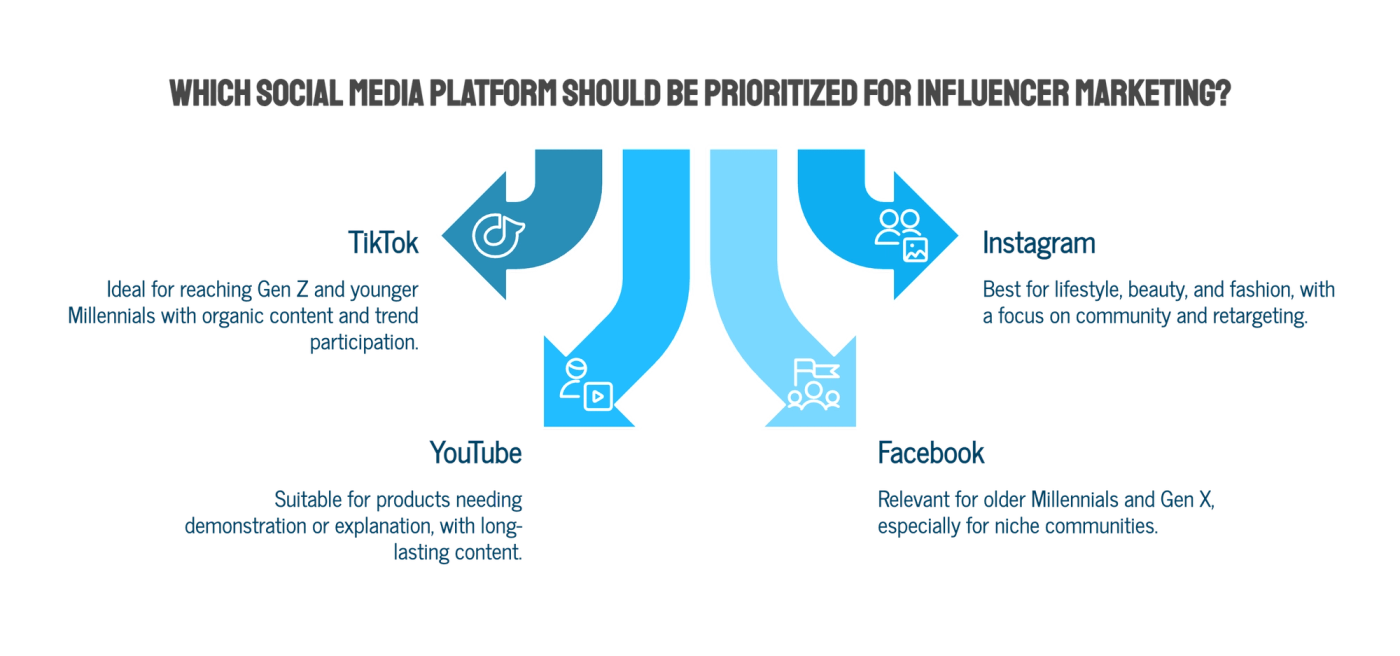
Each platform has a distinct content format, audience behavior, and distribution mechanic. A sound influencer marketing strategy doesn't default to all platforms simultaneously. It picks the platforms where your audience is most active and where your product category has proven traction.
TikTok is the highest-velocity platform right now for organic content reach. Short-form video from small creators can reach millions with no ad spend behind it. It rewards authenticity and trend participation over production quality, which makes it ideal for UGC-heavy strategies. If you're targeting Gen Z or younger Millennials, TikTok should be in the mix.
Instagram splits its value between Reels for discovery and Stories plus feed posts for retargeting and community. It's still the dominant platform for lifestyle, beauty, fashion, and food categories. Micro influencers on Instagram tend to have tighter, more loyal communities than their TikTok counterparts because the platform rewards sustained audience relationships over viral moments.
YouTube is the long game. Influencer content here has a much longer shelf life than short-form video, and reviews or tutorials continue to surface in search results for months or years after posting. For products that benefit from demonstration or explanation, YouTube belongs in your strategy even if it requires more lead time.
Facebook remains relevant for older Millennial and Gen X audiences, and specifically for niche communities organized around Groups. If your target customer is 35-plus, dismissing Facebook is a strategic mistake.
Decide on Creator Tier and Volume
Once you know your platform and audience, you need to decide what kind of creators you're working with and how many.
The creator tier breakdown:
- Nano (1K–10K followers): These creators have the highest engagement rates, the most niche audiences, and the lowest cost. They’re best suited for hyper-targeted campaigns or testing content concepts cheaply.
- Micro (10K–100K followers): This is the sweet spot for most brands. They deliver strong engagement, meaningful reach, and generally more polished deliverables than nano creators.
- Mid-tier (100K–500K followers): Mid-tier influencers offer greater reach with acceptable engagement. They’re often better for awareness at scale, although costs increase significantly.
- Macro and mega (500K+): These influencers provide mass reach but typically have low engagement rates relative to their follower count. They also come with high costs and lower conversion efficiency for most product categories.
- UGC Creators: These creators focus entirely on content creation rather than distribution. They produce ads, product demos, and short-form videos that brands can run across paid channels. This makes them one of the most efficient ways to generate high volumes of platform-native creative without paying for reach you don’t need.
Want to put this into practice?
SideShift connects you with vetted UGC creators who actually deliver. Start your free trial and post your first job in under 10 minutes.
Performance-driven brands are moving toward more creators, smaller followings, and higher content volume. One macro influencer posting twice a month gives you two data points. Twenty micro or UGC creators posting weekly gives you eighty data points, eighty chances to find what resonates, and eighty pieces of owned or licensed content to work with.
Build a Content Framework into Creator Briefs
A brief tells a creator what to make. A content framework tells your entire creator program what to test, how to iterate, and how to identify winning content. For brands running more than a handful of creators, the framework is what turns a campaign into a compounding content engine.
A basic content framework includes:
- Core messaging pillars: the 3 to 5 key messages about your product that every creator should understand, even if they express them differently
- Format variety: which content formats you want tested (unboxing, tutorial, review, lifestyle integration, before/after, trending audio)
- Creative guardrails: what creators can and cannot do or say on behalf of the brand
- Testing hypothesis: what specific variables are you trying to learn from this round of content (hook style, product angle, call-to-action placement)
- Iteration cadence: how frequently you review performance and update the brief based on what's working
This framework approach is borrowed from performance marketing, and it belongs in influencer strategy. The brands that find Content Market Fit (CMF) fastest are the ones treating each piece of creator content as a test, not a one-time deliverable.
Set Up Measurement Before the Campaign Launches
Measurement infrastructure and benchmarking need to be in place at the start of the campaign, not after the fact when you're trying to justify spending.
The metrics worth tracking depend on your goals, but a functional measurement stack typically includes:
- Unique tracking links or UTM parameters per creator so you can attribute traffic and conversions individually
- Engagement rate by creator to identify who's actually driving audience interaction
- View-to-click ratio for content with a direct CTA
- Conversion rate and cost per acquisition for bottom-funnel campaigns
- Content performance by format to understand which creative approaches are winning
Scale What Works and Cut What Doesn't
One of the most important habits in influencer marketing is learning to cut underperforming creators quickly while scaling the ones generating strong results. Running campaigns with higher creator volume makes this process easier because patterns emerge faster. Instead of relying on assumptions, you start seeing which creators, content styles, hooks, and audience angles consistently perform.
Build decision checkpoints into your campaign timeline, ideally within the first 2 to 4 weeks. Review metrics like engagement rate, watch time, click-through rate, saves, comments, and conversion performance. Then make active optimization decisions based on what the data is showing.
Scale creators whose content is outperforming by increasing posting frequency, expanding usage rights, testing additional hooks, or repurposing their content into paid ads. At the same time, avoid renewing partnerships that are not producing results, even if the creator seemed like a strong fit initially.
Want to put this into practice?
SideShift connects you with vetted UGC creators who actually deliver. Start your free trial and post your first job in under 10 minutes.
This is how high-volume UGC campaigns compound. Every round of testing gives your brand more creative data, sharper creator selection, and a better understanding of what actually resonates with your audience.
Build an Influencer Marketing Strategy with SideShift
Building a high-performing influencer marketing strategy comes down to three things: finding the right creators, enough content volume to generate real data, and the infrastructure to manage all of it without it becoming a full-time job. SideShift handles all three, and more.
With 800,000+ Gen Z creators ready to produce authentic short-form content across TikTok, Instagram, and YouTube, SideShift is where brands go when they're ready to stop treating influencer marketing like a one-off spend and start treating it like a scalable growth channel. Post jobs, recruit talent, send contracts, pay instantly, and track what's performing, all in one place.
FAQs
1. What is an influencer marketing strategy?
An influencer marketing strategy is a structured plan for using creators to reach a target audience, drive brand awareness, generate content, or increase conversions. A real strategy includes defined goals, a creator selection framework, a content plan, and measurement infrastructure. A brand deal without those components is a transaction, not a strategy.
2. How much should you budget for influencer marketing?
Budget depends heavily on your goals, creator tier, and campaign volume. Nano and micro influencer campaigns can begin producing meaningful results in the $2,000 to $10,000 per month range when paired with a high-volume UGC approach. Macro influencer campaigns typically require significantly higher investment with less predictable ROI. Many brands are finding better returns by spreading budget across more creators at lower individual rates than concentrating it in one or two large partnerships.
3. What's the difference between influencer marketing and UGC marketing?
Influencer marketing relies on a creator's existing audience for distribution. UGC marketing focuses on the content itself, which the brand owns and deploys through its own channels or paid media. Many high-performing brand strategies use both: UGC creators to produce volume content and micro influencers to distribute it with audience trust. SideShift specializes in the UGC side, connecting brands with creators who produce content at scale.
4. How do you measure the ROI of an influencer marketing campaign?
Track creator-specific performance using unique UTM links or promo codes per creator. Measure engagement rate, click-through rate, and conversion rate at the individual creator level so you know exactly who's delivering value. For awareness campaigns, track reach, view completion rate, and brand search volume lift. ROI gets clearer the more granular your tracking is from the start.
5. How many influencers does your brand need for a successful campaign?
There's no universal number, but brands consistently underestimate the volume required to get statistically meaningful performance data. Running three to five creators gives you almost no signal. Running twenty to fifty gives you enough variation to identify content that's working and cut what isn't. High-volume UGC campaigns on platforms like SideShift typically operate with dozens of active creators simultaneously, which is what makes rapid iteration and real optimization possible.