
Influencer Marketing Reporting: Metrics & ROI Guide
Track influencer marketing ROI with metrics like engagement rate, CPA, and conversions, and connect creator performance directly to revenue outcomes.

Table of Contents
Influencer Marketing Reporting: Key Metrics and How to Track ROI
Most brands running influencer campaigns can tell you how many views a video got. Far fewer can tell you how many sales it drove. That gap between vanity metrics and actual business outcomes is where influencer marketing reporting either earns its keep or exposes wasted budget.
This guide breaks down the metrics that matter, how to calculate ROI in a way that holds up to scrutiny, and what to do when the data tells you something you didn't expect.
What Is Influencer Marketing ROI?
ROI in influencer marketing is the ratio of revenue generated to total campaign spend, but stopping there undersells how complex (and revealing) the measurement actually gets.
Influencer marketing ROI accounts for creator fees, product seeding costs, ad spend on whitelisted or boosted content, and any platform or agency fees layered on top. The revenue side is where most brands struggle, because creator-driven purchases rarely announce themselves.
Unlike paid search, where a click leads cleanly to a conversion, influencer content lives in a messier attribution environment. Someone watches a TikTok, closes the app, searches your brand name three days later, and converts through a Google ad. That sale gets credited to the search, not the creator who sparked the intent. Accurate influencer marketing ROI reporting requires closing that gap through smarter attribution infrastructure, not just better dashboards.
It’s also worth understanding the difference between direct ROI and brand ROI. Direct ROI measures immediate conversions and revenue. Brand ROI captures longer-term value: increased search volume, lower customer acquisition cost over time, and higher conversion rates from warmer audiences. Both matter, and collapsing influencer performance into a single number often flattens the picture more than it clarifies it.
Key Metrics for Measuring Influencer Marketing ROI
Not every metric belongs in every report, but the following are the ones that reliably connect creator activity to business outcomes.
Engagement Rate
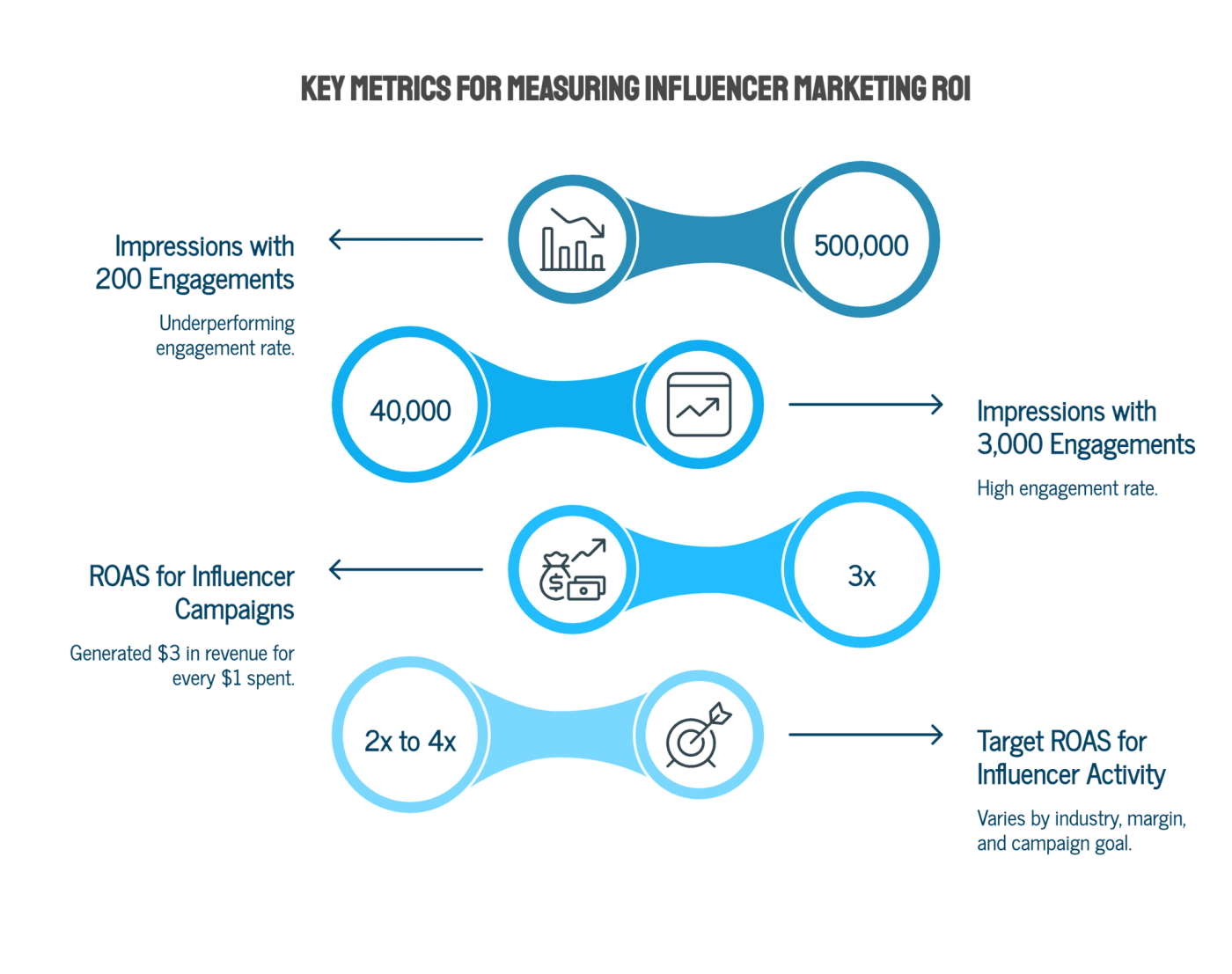
Engagement rate (likes, comments, shares, and saves divided by reach or impressions) tells you whether content is resonating, not just being seen. A post with 500,000 impressions and 200 engagements is underperforming. One with 40,000 impressions and 3,000 engagements is doing something right. High engagement rate signals that the content format, hook, and messaging are landing with the right audience, which is a leading indicator of conversion performance.
Click-Through Rate (CTR)
CTR measures how many viewers took the next step and visited your site, landing page, or product listing. This is where influencer content either translates to intent or stalls. Low CTR despite high engagement usually points to a mismatch between the content experience and the CTA, or a link placement that's too buried to act on. Tracking CTR by creator and by content type lets you diagnose that problem fast.
Conversions and Cost Per Acquisition (CPA)
Conversions are the purchases, sign-ups, free trials, or other actions you defined as the campaign goal. CPA divides total campaign spend by the number of conversions. A $15,000 campaign that drives 300 purchases has a $50 CPA. Whether that's good depends on your average order value and customer lifetime value, but CPA gives you a consistent benchmark to measure creators against each other and against other acquisition channels.
Want to put this into practice?
SideShift connects you with vetted UGC creators who actually deliver. Start your free trial and post your first job in under 10 minutes.
Return on Ad Spend (ROAS)
ROAS is revenue divided by total ad spend, and for influencer campaigns, it's most useful when creator fees are treated as part of that spend. A 3x ROAS means you generated $3 in revenue for every $1 spent on the campaign. Many brands target a minimum 2x to 4x ROAS for influencer activity, though this varies significantly by industry, margin structure, and whether the campaign is oriented toward acquisition or retention.
Additional Metrics Worth Tracking
- Reach and impressions: Volume of exposure, useful for brand awareness benchmarks
- View-through rate: How much of a video was actually watched, a signal of content quality
- Saves and shares: High-intent engagement that often precedes purchase
- Earned media value (EMV): The estimated cost of generating equivalent organic reach through paid media
- Incremental revenue: Revenue attributable specifically to the influencer channel, isolated from baseline sales
How to Track Influencer Marketing ROI
Knowing which metrics matter is step one. Building the infrastructure to actually capture them is where most brands hit friction.
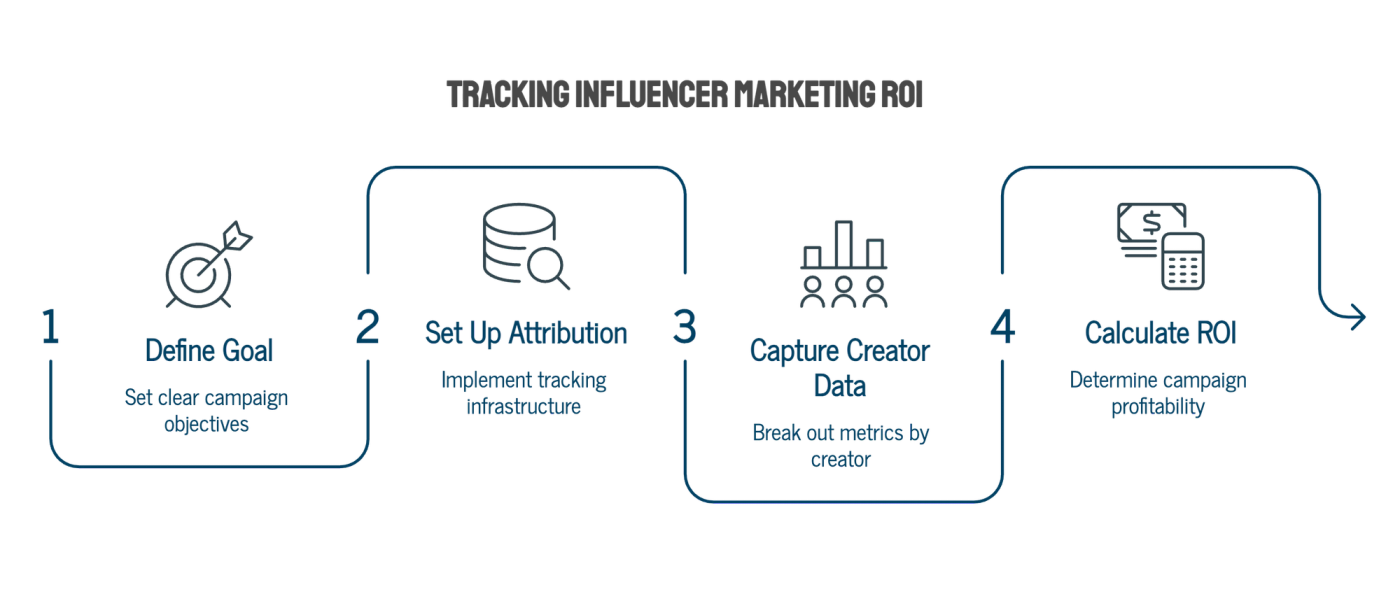
Step 1: Define the Goal Before the Campaign Launches
ROI measurement starts with clarity on what you're actually trying to drive. Brand awareness, first purchases, app downloads, email sign-ups, and repeat purchases all require different measurement setups. Trying to retroactively assign a goal to a campaign that already ran is a reliable way to get misleading numbers.
Step 2: Set Up Attribution Infrastructure
- UTM parameters: Tag every link with source, medium, campaign, and creator identifiers so traffic and conversions can be traced back in Google Analytics or your analytics platform of choice
- Unique discount codes: Creator-specific promo codes are one of the cleanest attribution signals available, especially for first-touch purchases
- Trackable landing pages: Dedicated landing pages per creator or per campaign remove ambiguity about where traffic originated
- Pixel tracking: Retargeting pixels capture users who engaged with influencer content, even if they didn't convert immediately
Step 3: Capture Data at the Creator Level
Aggregate campaign performance hides what's actually happening. A single top-performing creator can carry an entire campaign while three others underperform. Breaking out metrics by creator, by content format, and by posting time reveals what's driving results and what's draining budget.
Step 4: Calculate ROI
(Revenue Generated - Total Campaign Cost) / Total Campaign Cost × 100
If your campaign generated $60,000 in revenue and cost $20,000 to run, that's a 200% ROI. Include all costs in the denominator: creator fees, product costs, platform fees, any paid amplification, and internal time spent managing the campaign.
Step 5: Build a Reporting Cadence
- Weekly: Check CTR, conversion rate, and engagement by creator. Flag underperformers early enough to adjust
- Monthly: Analyze trends, calculate CPA and ROAS, identify top-performing content types
- Post-campaign: Full ROI analysis, creative performance breakdown, and recommendations for the next cycle
What's a Good ROI for Influencer Marketing?
Want to put this into practice?
SideShift connects you with vetted UGC creators who actually deliver. Start your free trial and post your first job in under 10 minutes.
Industry benchmarks put average influencer marketing ROI at around $5.78 returned for every $1 spent, but that number is an average across wildly different campaign structures, industries, and budget levels. The more useful question is what's a good ROI for your specific business, given your margins, your acquisition costs in other channels, and the lifetime value of customers you're acquiring.
A few patterns that reliably improve ROI:
- Volume over celebrity: High-volume UGC campaigns consistently outperform single high-cost influencer posts because they create more surface area for content to find its audience. SideShift's network of 800,000+ creators is built specifically around this principle.
- Always-on > one-off: Sustained creator campaigns build algorithm momentum and audience familiarity over time. A single campaign spike rarely builds the kind of trust that drives repeat purchase behavior.
- Content market fit: The brands getting outsized ROI from creator content have figured out which hook, format, and messaging style connects with their audience. That discovery process requires running enough volume to generate statistically meaningful signals.
Maximize Influencer Marketing ROI with SideShift
If your influencer marketing reporting keeps surfacing the same problem, that results are inconsistent, attribution is muddy, and it's impossible to tell which creators are actually driving revenue, the issue is usually upstream.
SideShift is built to solve exactly that. As a dual-sided creator marketplace connecting brands with over 800,000 Gen Z creators, SideShift gives brands the tools to run high-volume UGC campaigns with the kind of built-in measurement infrastructure that makes reporting actually useful. Campaign analytics, creator performance tracking, and leaderboards surface what's working in real time. Payments, contracts, and attribution are handled inside the same system, so the data is clean and traceable by default.
With a system designed to unify execution and measurement, brands can finally move from guesswork to predictable, scalable performance.
Join SideShift for free today.
FAQs
1. What is influencer marketing reporting?
Influencer marketing reporting tracks how creator campaigns perform using metrics like engagement rate, clicks, conversions, and revenue attribution. It connects content activity to business outcomes so brands can understand what's working, what's not, and where to put budget next.
2. Which metrics matter most in influencer marketing reporting?
The metrics with the most direct connection to business results are engagement rate, click-through rate, conversions, cost per acquisition (CPA), and return on ad spend (ROAS). Reach and impressions matter for brand awareness goals, but shouldn't be the primary performance signals for conversion-focused campaigns.
3. How do you calculate ROI from influencer campaigns?
Take total revenue generated from the campaign, subtract total campaign costs (creator fees, product seeding, platform fees, paid amplification), then divide by total costs and multiply by 100. A campaign that cost $10,000 and generated $40,000 in revenue has a 300% ROI.
4. How can you track influencer-driven conversions?
The most reliable methods are unique discount codes per creator, UTM-tagged links in bios and stories, dedicated landing pages by campaign, and retargeting pixels that capture users who engaged with content before converting. Using multiple attribution signals together gives you a more complete picture than relying on any one method.
Want to put this into practice?
SideShift connects you with vetted UGC creators who actually deliver. Start your free trial and post your first job in under 10 minutes.
5. How often should influencer marketing reports be updated?
Weekly check-ins are enough to catch underperformers and flag content that's gaining traction before it peaks. Monthly analysis should go deeper: CPA trends, ROAS by creator tier, and content format performance. After each campaign cycle, a full retrospective review helps carry learnings into the next round rather than starting from scratch.