
Influencer Marketing in E-Commerce: A Full Guide
Influencer marketing can drive real e-commerce growth, but only with the right cost structure, creator mix, and content volume. Here's what actually works.
Table of Contents
Influencer Marketing in E-commerce: Benefits, Costs, and Strategy
E-commerce brands have more channels competing for their budget than ever before, and paid media costs keep climbing. Cost-per-click on Meta rose 11% to $1.72 in 2026. Google Shopping is more competitive by the quarter, and the returns on traditional digital advertising are compressing across the board.
Influencer marketing entered this environment as a compelling alternative, and for e-commerce specifically, it has proven to be one of the most effective channels for driving both discovery and conversion when it's executed with real strategy behind it.
This guide covers what influencer marketing actually delivers for e-commerce brands, what it realistically costs, and how to structure a strategy that performs rather than just produces content.
How Influencer Marketing Works Differently for E-Commerce
Influencer marketing isn't equally effective across every industry. For e-commerce, it maps almost perfectly onto the purchase journey in ways that make it uniquely powerful compared to other verticals. The reason comes down to how people shop online.
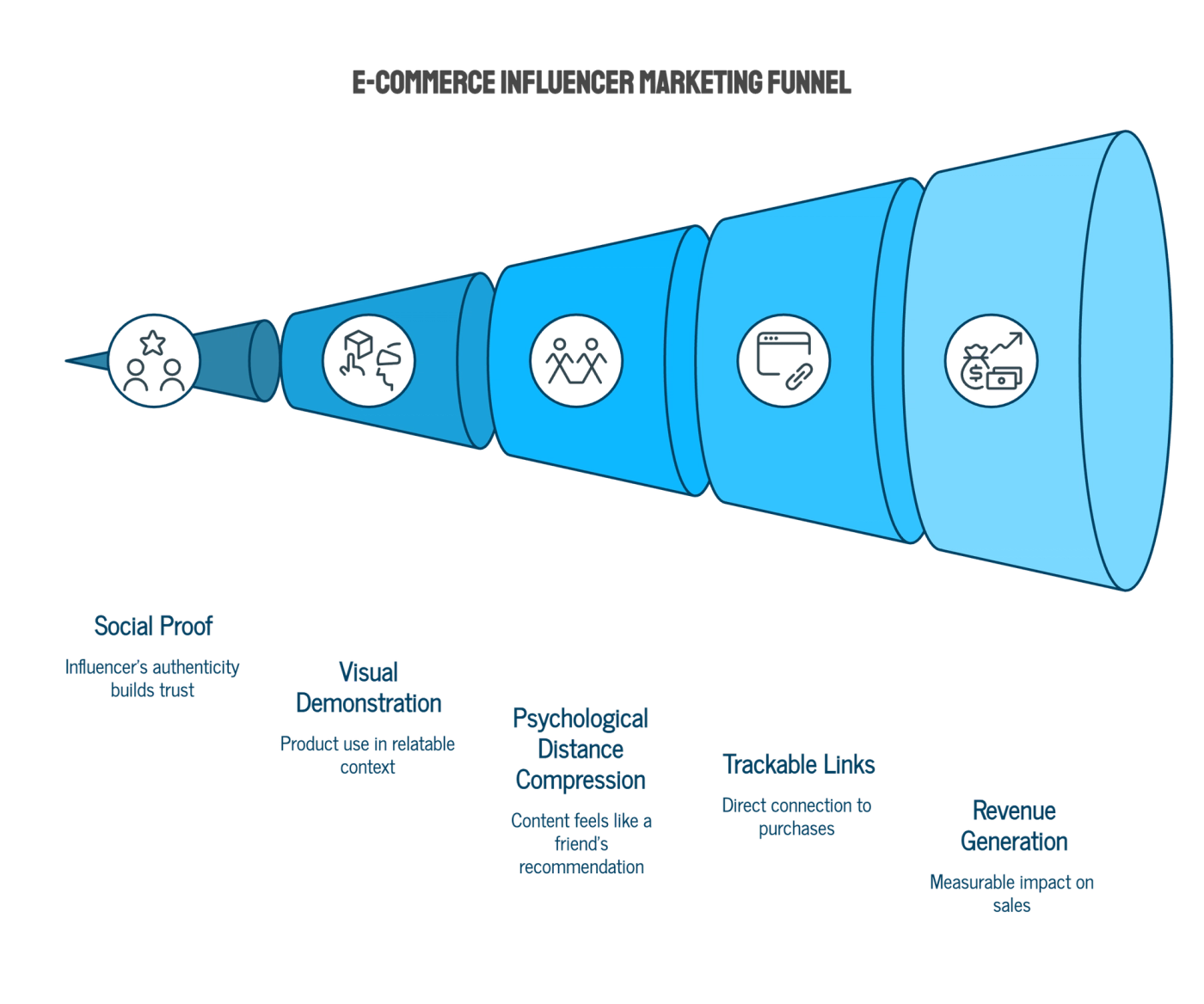
E-commerce purchases, especially in categories like beauty, apparel, home goods, fitness, and food, are heavily influenced by social proof and visual demonstration. A customer scrolling TikTok who watches a creator unbox a product, use it authentically, and react genuinely is experiencing something closer to a friend's recommendation than an advertisement. That distinction matters enormously for conversion.
People buy from people they trust, and when an influencer or UGC creator demonstrates a product in a relatable context, the psychological distance between content and purchase compresses significantly.
E-commerce brands also benefit from the measurability of influencer campaigns in ways that brand-focused industries don't always see. With trackable links, promo codes, and pixel-based attribution, you can connect influencer content directly to cart additions, purchases, and revenue. That closes the loop between content investment and business outcome, making influencer marketing one of the more defensible line items in an e-commerce marketing budget.
Benefits of Influencer Marketing for E-Commerce Brands
Understanding the specific advantages helps e-commerce brands allocate their influencer investment more intentionally rather than treating it as a general awareness play.
Warm Traffic With Higher Purchase Intent
Traffic that arrives from an influencer recommendation is pre-qualified in a way that paid search and display traffic isn't. The creator has already provided context, demonstrated the product, and implicitly endorsed it. By the time a viewer clicks through to your product page, they've already seen it in use and heard a trusted voice speak to its value. Conversion rates on influencer-referred traffic consistently outperform cold paid traffic for this reason.
People trust people more than they trust brands.
Content at Scale That Doubles as Creative Assets
Every piece of content a creator produces for your brand is a potential asset beyond the original post—but only if usage rights have been secured upfront.
By default, influencers own the intellectual property they produce. That means a brand cannot legally repurpose, boost, or run that content as a paid ad without explicit permission negotiated in advance, typically through a licensing agreement or a work-for-hire clause in the contract.
Want to put this into practice?
SideShift connects you with vetted UGC creators who actually deliver. Start your free trial and post your first job in under 10 minutes.
Usage rights should specify the platforms, duration, and whether the content can be used for paid media, not just organic distribution. If this isn't addressed before a shoot or campaign begins, brands often find themselves paying separately to license content they've already paid to have made.
This is where UGC creators differ from traditional influencers. With UGC-style engagements, broad usage rights including paid ad use are typically built into the arrangement by default, because the entire point of the relationship is content production for the brand's channels, not organic posting to the creator's audience. With traditional influencer partnerships, usage rights are a separate negotiation and can add meaningfully to the total cost.
When that distinction is handled correctly upfront, a creator program running at volume generates organic distribution through the creator's audience and builds an advertising creative library that feeds your paid media channels. UGC-style creator content performs exceptionally well as paid social creative precisely because it doesn't look like an ad, but getting there legally requires the rights conversation to happen before the brief goes out, not after.
Compounding Brand Trust in Competitive Categories
In crowded e-commerce categories, the brand with the most social proof wins. Influencer content creates the impression of organic community enthusiasm around a product, which is more convincing than any brand-produced campaign. When multiple creators are posting about the same product across the same time period, it creates the kind of cultural momentum that paid ads alone cannot replicate.
Algorithm-Friendly Organic Distribution
On TikTok especially, organic creator content can reach audiences many times larger than a creator's follower count if the algorithm picks it up. This represents free distribution on top of the creator fee, and it's a lever that doesn't exist in paid media. A single piece of creator content that goes semi-viral can generate hundreds of thousands of impressions at no additional cost to the brand.
Understanding the Cost of Influencer Marketing for E-Commerce
One of the biggest sources of confusion for e-commerce brands entering influencer marketing is understanding where the money actually goes and what realistic returns look like. The cost structure varies significantly depending on creator tier, platform, content format, and whether you're paying for reach or content.
Creator Fee Ranges by Tier
Influencer rates have no fixed standard. Two creators with identical follower counts can quote you $200 and $2,000 for the same deliverable. The cost of influencer marketing for e-commerce is driven by niche, engagement quality, content format, and whether paid usage rights are baked in. These ranges reflect what most e-commerce brands are actually paying at each tier in 2026.
- Nano influencers (1K-10K followers): $25 to $150 per post. They offer low costs, high engagement rates, and are useful for testing content concepts or reaching hyper-niche audiences.
- Micro influencers (10K-100K followers): $100 to $500 per post on Instagram, slightly lower on TikTok. They represent the best value tier for most e-commerce brands in terms of engagement relative to cost.
Want to put this into practice?
SideShift connects you with vetted UGC creators who actually deliver. Start your free trial and post your first job in under 10 minutes.
- Mid-tier (100K-500K followers): $500 to $5,000 per post. They provide a meaningful reach increase, but engagement rates are typically lower and cost-per-engagement is often higher.
- Macro and mega influencers (500K+): $5,000 to $50,000+ per post. They’re generally reserved for major product launches or brands with significant brand equity goals. ROI is harder to justify for most e-commerce budgets.
UGC Creator Rates for E-Commerce
If you're hiring creators to produce content your brand owns and deploys rather than for distribution through their audience, the pricing structure changes.
UGC creators typically charge per deliverable rather than per post to their audience. Rates for a single UGC video range from $50 to $300 depending on creator experience, usage rights, and deliverable complexity. For ongoing monthly arrangements, SideShift recommends hybrid structures: a retainer of $300 to $900 per month for consistent content output, combined with performance bonuses tied to view counts or conversion events. This model attracts better creators and aligns their incentive with your performance goals.
Platform and Management Costs
Beyond creator fees, factor in the cost of the infrastructure used to manage campaigns. DIY management through spreadsheets and direct outreach has a high hidden cost in staff time.
This is why many brands eventually adopt creator marketplace platforms and campaign management platforms. Pricing can range from free plans with limited functionality to more advanced systems built for large-scale recruitment, workflow management, and analytics.
SideShift’s plans start at $199 per month for Starter, $299 for Growth, and $999 for Scale, with each tier increasing access to creator recruitment, campaign volume, and hiring capabilities.
How to Build an Influencer Marketing Strategy for E-Commerce
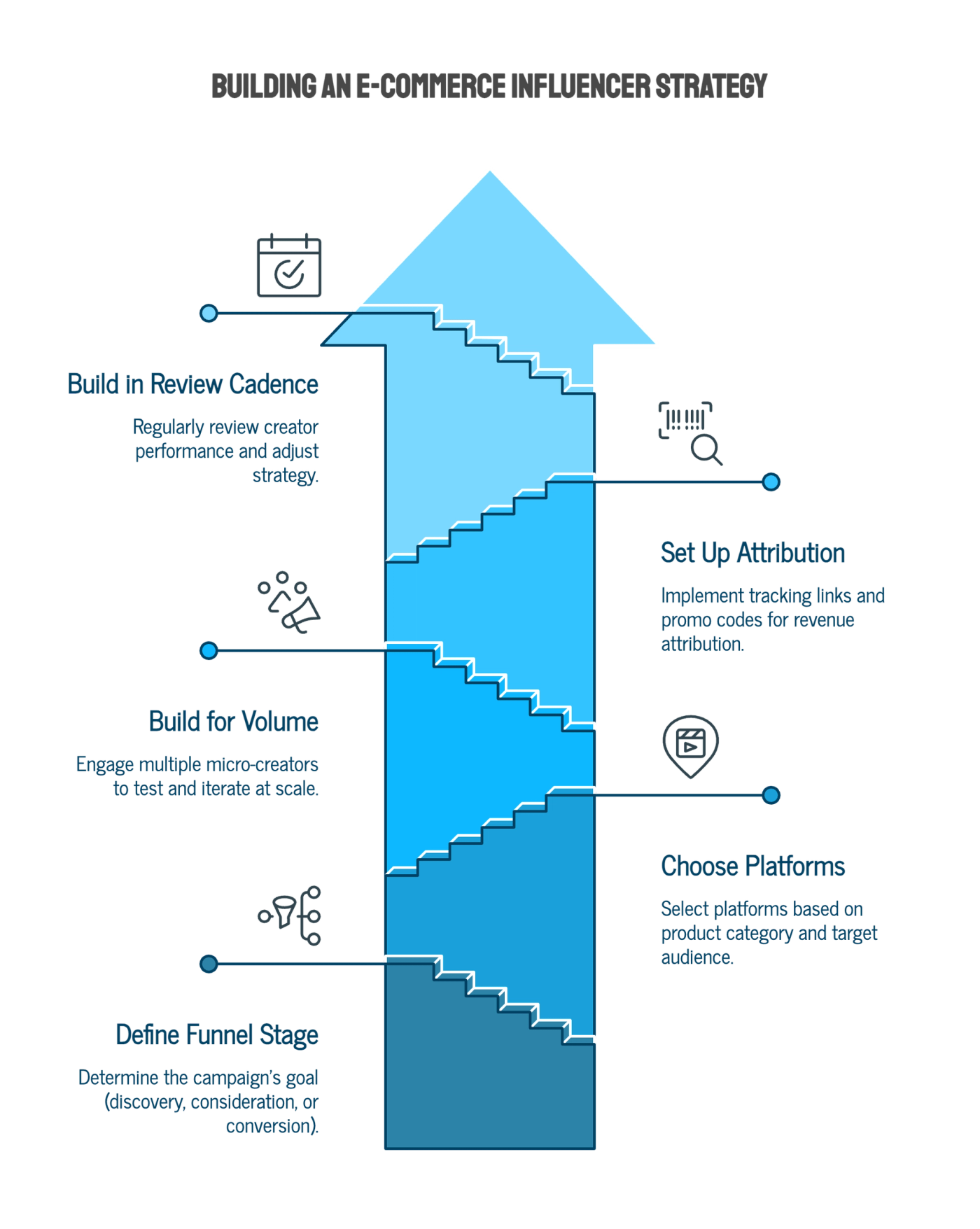
A strategy for e-commerce influencer marketing looks different from a general brand awareness campaign. The goal is almost always tied to a revenue outcome, which means the strategy needs to be built with attribution, iteration, and content volume in mind from day one.
Step 1: Define Your Funnel Stage and Metric
Decide whether this campaign is meant to drive top-of-funnel discovery, mid-funnel consideration, or bottom-funnel conversion. Each stage requires different creator types, content formats, and success metrics.
- Discovery: Optimize for reach and content volume. For example, a new food brand launching on TikTok might deploy 30 nano and micro-creators posting recipe or taste-test content if the goal is exposure over immediate sales.
- Consideration: Optimize for engagement and saves. For instance, a wellness brand might work with trusted mid-tier creators to produce educational content that answers buyer objections and keeps the brand top of mind.
- Conversion: Optimize for click-through rate and cost per acquisition. For example, a DTC brand running UGC as paid ads with creator-specific promo codes is a classic bottom-funnel play where every metric ties directly to revenue.
Step 2: Choose Platforms Based on Product Category
Platform selection should follow product behavior, not personal preference or where your brand already has a following. Different categories convert differently on each platform, and spreading budget evenly across all of them is one of the more common ways e-commerce brands dilute their results.
Want to put this into practice?
SideShift connects you with vetted UGC creators who actually deliver. Start your free trial and post your first job in under 10 minutes.
- TikTok: best for impulse-purchase categories, products with strong visual demonstration, and brands targeting under-35 audiences
- Instagram: strong for lifestyle, beauty, apparel, food, and home categories with established visual aesthetics
- YouTube: most effective for higher-consideration purchases where the buyer wants detailed demonstration before committing
- Facebook: relevant for reaching Millennial and Gen X shoppers, particularly in home, wellness, and family product categories
Step 3: Build for Volume
The e-commerce brands seeing the strongest influencer ROI right now are not the ones landing a single headline partnership with a major creator. They're the ones running 20, 30, or 50 micro and UGC creators simultaneously, testing hooks, formats, and product angles at scale, and using performance data to identify what drives purchase intent. Volume is what creates the data density to iterate meaningfully.
Step 4: Set Up Attribution Before You Launch
Every creator in your program should have a unique tracking link or promo code that lets you attribute traffic and conversions directly to their content. Without this infrastructure in place at launch, you'll have no reliable way to determine which creators are driving revenue and which are just generating impressions.
Step 5: Build in a Review Cadence
Set a performance review at 2 to 4 weeks into the campaign. Identify your top-performing creators by conversion rate and content engagement, increase their output or extend their contracts, and don't renew with creators whose content isn't producing meaningful signals. This active management is what separates a compounding influencer program from a flat one-time campaign spend.
Common Mistakes E-Commerce Brands Make With Influencer Marketing
Even well-resourced e-commerce brands make predictable errors that undercut their influencer investment. Knowing them in advance is straightforward insurance.
- Over-investing in one large creator instead of distributing across many smaller ones: A single macro influencer is a single bet. Twenty micro creators is a diversified portfolio with more data, more content, and more resilience if one partnership underperforms.
- Treating influencer content as separate from paid media: The best e-commerce brands treat top-performing UGC and creator content as fuel for their paid social campaigns. When a creator video performs organically, putting paid spend behind it amplifies a proven creative asset rather than gambling on untested brand-produced content.
- Skipping the brief and expecting great content: Creators need a clear content framework: key messages, product benefits to highlight, calls to action, and any brand guardrails. Without it, you get content that might be entertaining but doesn't drive purchase.
- Measuring only vanity metrics: Impressions and likes don't pay for inventory. Track click-through rate, conversion rate, and revenue attributed per creator from the start.
Scale Your Creator Program on SideShift
Sourcing creators, managing applications, sending contracts, processing payments, and tracking performance across dozens of active partnerships simultaneously is a job in itself, before you've done any of the creative or strategic work.
SideShift is the platform built for e-commerce brands that are doing this manually. With 800,000+ Gen Z UGC creators in the network, brands can post jobs, recruit at scale, and run high-volume creator campaigns with contracts, payouts, and analytics all handled in one place. The brands winning in competitive e-commerce categories right now aren't outspending their competitors on paid ads. They're out-contenting them with creator programs that produce authentic, high-converting content faster than any in-house team could.
Want to put this into practice?
SideShift connects you with vetted UGC creators who actually deliver. Start your free trial and post your first job in under 10 minutes.
SideShift's hybrid pay model, retainer plus performance bonuses, means creators are incentivized to produce content that performs, not just content that gets submitted.
FAQs
1. Is influencer marketing worth it for small e-commerce brands?
Yes, particularly when the focus is on micro and UGC creators rather than expensive macro partnerships. Small e-commerce brands can run effective creator programs with relatively modest budgets by working with nano and micro influencers who have highly engaged niche audiences. The key is volume and iteration: running enough creators to generate meaningful performance data and adjusting based on what's actually converting.
2. How to measure ROI on influencer marketing for e-commerce brands?
The most reliable method is unique tracking links or promo codes per creator that connect directly to your e-commerce platform's analytics. Track revenue attributed per creator, cost per acquisition by creator, and content engagement rate. Compare these against your cost per creator to calculate return. For brands running paid media, also track which influencer creative assets perform best as ad creative, since that extends the ROI calculation beyond organic reach.
3. What type of influencer content works best for e-commerce?
Product demonstration and honest review formats consistently outperform lifestyle-only content for e-commerce conversion. Content that shows the product being used, addresses a specific problem it solves, or includes a genuine before-and-after drives stronger purchase intent than aspirational brand imagery. Unboxing content, tutorials, and “reasons I switched to this product” style videos perform particularly well on TikTok and Instagram Reels.
4. Should e-commerce brands work with influencers or UGC creators?
Both serve different functions and the strongest programs use both. Influencers provide distribution through their audience. UGC creators provide content assets the brand owns and can deploy through paid media, email, and owned social channels. For most e-commerce brands starting out, UGC creators offer better cost efficiency and content volume, while influencer partnerships add reach and third-party credibility as the program matures.
5. How many creators do you need to run an effective e-commerce influencer campaign?
More than most brands assume. Running fewer than ten creators gives you insufficient data to identify what's working. A minimum of fifteen to twenty active creators posting consistently is a reasonable starting point for generating actionable performance signals. High-performing e-commerce brands running through platforms like SideShift typically operate with 30 to 100 or more creators in active rotation, which is what enables the rapid testing and iteration that drives compounding results.