
How to Optimize Influencer Campaigns: A 2026 Guide
Discover how to optimize influencer campaigns, test content, and scale creator partnerships using SideShift’s 2026 guide.
Table of Contents
How to Optimize Influencer Campaigns: A 2026 Guide
Influencer marketing is more established. What began as a world of great products and one-time partnerships has turned into a performance-driven environment where businesses want to see measurable ROI and creators want to be true partners.
The question now isn’t how to start an influencer campaign or if it works. But rather, how can you optimize said campaigns?
The brands that get viral reach are different from the ones that make money over time because they optimize their campaigns. It's not enough to just pick the perfect influencer. You also need to put creative direction, timing, and analytics together into a repeatable influencer marketing approach that becomes better with each campaign.
Why Optimization Is More Important Than Ever
Influencer Marketing Hub says that by the end 2026, brand budgets will exceed $24 billion. Still, a lot of brands have trouble linking creator output to results that can be measured.
Without optimization, influencer campaigns typically hit a wall: plenty of engagement but no sales, beautiful content that doesn’t fit with the funnel goals, or creators posting independently.
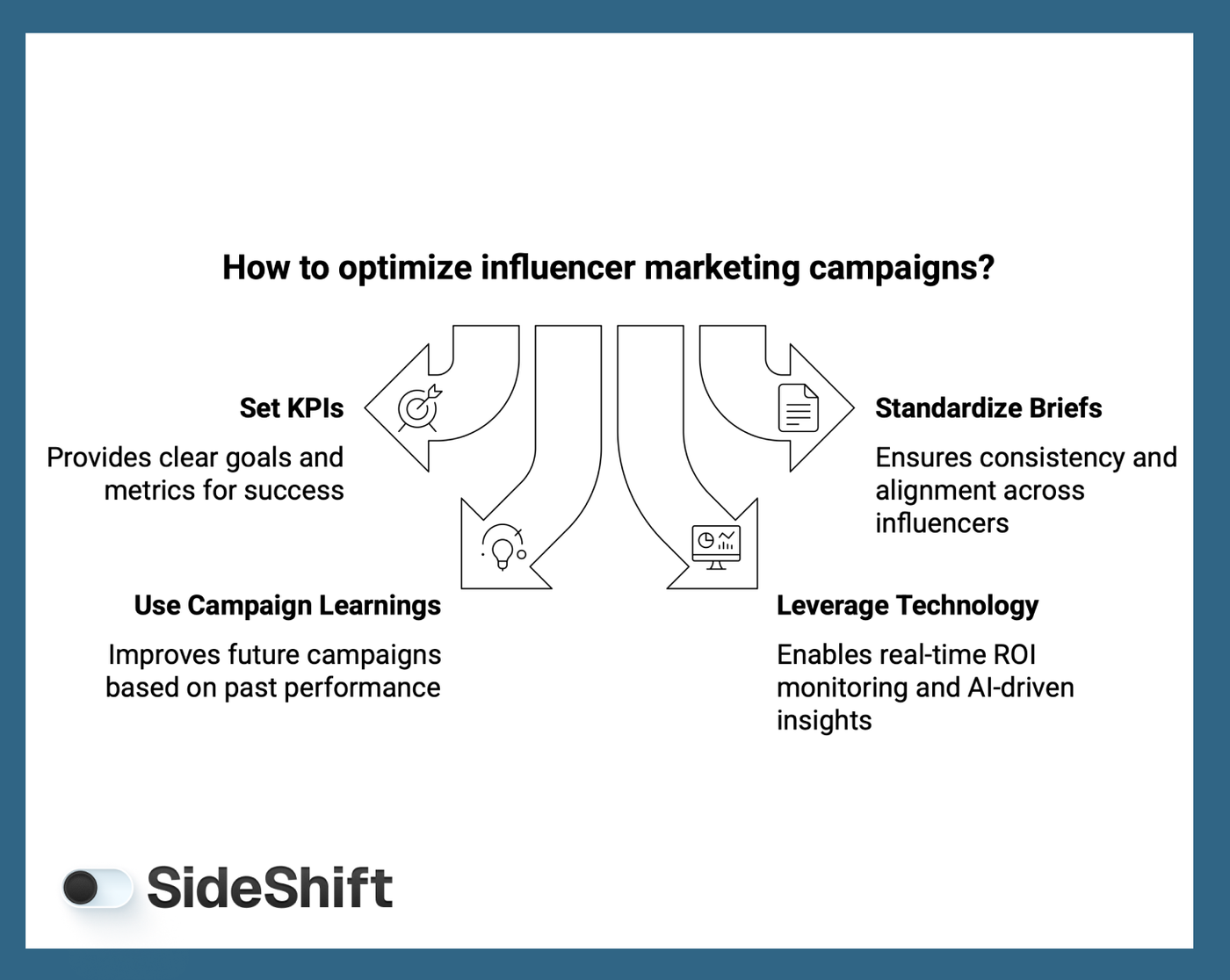
These gaps are corrected by optimization. It gives structure by setting KPIs, making briefs the same for each influencer, and using what you learn from one campaign to the next. When brands can predict how when their marketing will work, they can use influencer marketing as a real growth channel instead of just a creative experiment.
Technology is what makes the next phase of optimization possible. And, with AI-driven insights, creator markets, and first-party analytics tools, you can now monitor ROI in real time.
What to Optimize In an Influencer Campaign
Choosing the Right Creator
The foundation of any optimized campaign is the right creator fit. Are you looking for a nano influencer or a macro influencer? While follower count is still important, the success of an influencer campaign depends more on how well the creator's audience matches your brand's target client. Don't just look at how many people are engaged. Are the comments real or bots? Are people asking questions, tagging friends, or clicking through?
Use both your gut and the facts. Metrics like average view time, audience location, and sentiment analysis are important, but so are a creator's tone and way of expressing stories. The right partner will sound like a natural part of your brand language.
SideShift lets brands go through vetted Gen Z creators in every niche, filter by content type, and find partners that currently make content that is similar to yours. Finding creators that already speak the language of your audience is the first step in optimization.
Briefing and Creative Direction
A creative brief is the campaign’s blueprint. It aligns brand goals with creator authenticity. A good brief has the following:
Objective clarity: Is the purpose to raise awareness, get people to convert, or get more user-generated content to run as paid ads?
Deliverable details: includes format, tone, hooks, hashtags, and usage rights.
Creative freedom: means giving innovators the ability to interpret brand language instead of copying it.
Want to put this into practice?
SideShift connects you with vetted UGC creators who actually deliver. Start your free trial and post your first job in under 10 minutes.
Too strict briefs kill authenticity, while too vague ones lead to results that don't match the brand. So, the best briefs have a good mix of structure and room for personality.
A drink business might, for instance, try out two ideas: one that focuses on the product and one that focuses on the lifestyle. Data might show that taste-test videos made by regular people are better than polished commercials. That information is then used to write every other creator brief.
If you're not sure what a social media content creator is, check out our guide for examples of roles and types of content they create.
Testing the Content
Experimentation is key to optimization.
You can test at many levels, such as the hooks, message, the visuals, the platform, or the call to action. Marketers might try out different formats for "unboxing," "tutorial," and "testimonial," or they could compare a 15-second hook to a 30-second story.
Brands who A/B test influencer creative on a regular basis get 30% more return on investment. Testing turns gut feelings into facts and facts into trust.
The "test, learn, scale" model is how modern workflows work. To get things going, find the influencer that best represents your brand. Over time, they will naturally build their presence, and the collaboration will only get better with time. It's a mix of creative testing and media efficiency.
SideShift's analytics dashboard puts all of this information in one place, giving numbers for engagement, reach, and video performance by creator, campaign, and genre of content. Brands can quickly see what works and put money back into things that do.
Platform Optimization
Each platform has its own set of creative rules. TikTok, for example, promotes creators that can build the largest engagement and can hold the longest watch time. Instagram Reels get shown to followers first and encourage shares outside of the platform.
When you optimize across platforms, you make the same idea work in different settings. Changes as subtle as the length of a caption, the positioning of text, or the choice of music can have a big effect on engagement.
Meta's Adapt to Placement and TikTok's Creative Exchange have made formatting easier, but the best businesses still make their own. They don't change the size of the content; they change how it is interpreted.
For example, an optimized influencer marketing approach might test the same narrative on TikTok, Reels, and Shorts to see which one gets the most views and conversions. Cross-platform optimization doesn't just get you more views; it also helps you learn more.
Campaign Timing and Cadence
Repetition makes things more familiar, and familiarity leads to conversion.
You should organize your posting schedule like a media airplane. A one-time influencer activation could get you some quick attention, but long-term collaborations with creators build over time. When people witness a trusted creator use your product again and over again, they start to believe in it.
Brands should plan their scheduling around product launch cycles and seasonality (looking at you Black Friday / Cyber Monday), but they should also provide room for organic growth. For evergreen items, stagger creator posts every week to keep a continuous beat instead of a single spike.
Want to put this into practice?
SideShift connects you with vetted UGC creators who actually deliver. Start your free trial and post your first job in under 10 minutes.
For ongoing optimization, mix influencer material with user-generated content (UGC) because it fills that gap between larger campaigns, keeping audiences engaged year-round.
Keeping Track of Performance and KPIs
Measurement is necessary for optimization. Advanced marketers keep an eye on more than just the engagement rate. They also look at the click-through rate, conversion rate, average order value, sentiment score, and cost per acquisition. These two things together show what really affects company outcomes, not simply awareness.
Break KPIs up into funnel stages:
Awareness: reach, impressions, and saves
Consideration: watch-time, comments, and shares
Conversion: sales, sign-ups, and tracked link clicks
According to Sprout Social's 2025 Social Media statistics, campaigns that use popular influencer content as advertising experience an average 27 percent increase in engagement. That's distribution-based optimization.
Finally, give credit where credit is due to close the loop. To find out the real ROI, connect influencer links to CRM or pixel data. You can see how many people have converted directly from creative content with SideShift's built-in dashboards, so you don't need any spreadsheets.
How to Use Data to Scale What Works
Until ideas lead to action, optimization isn’t done.
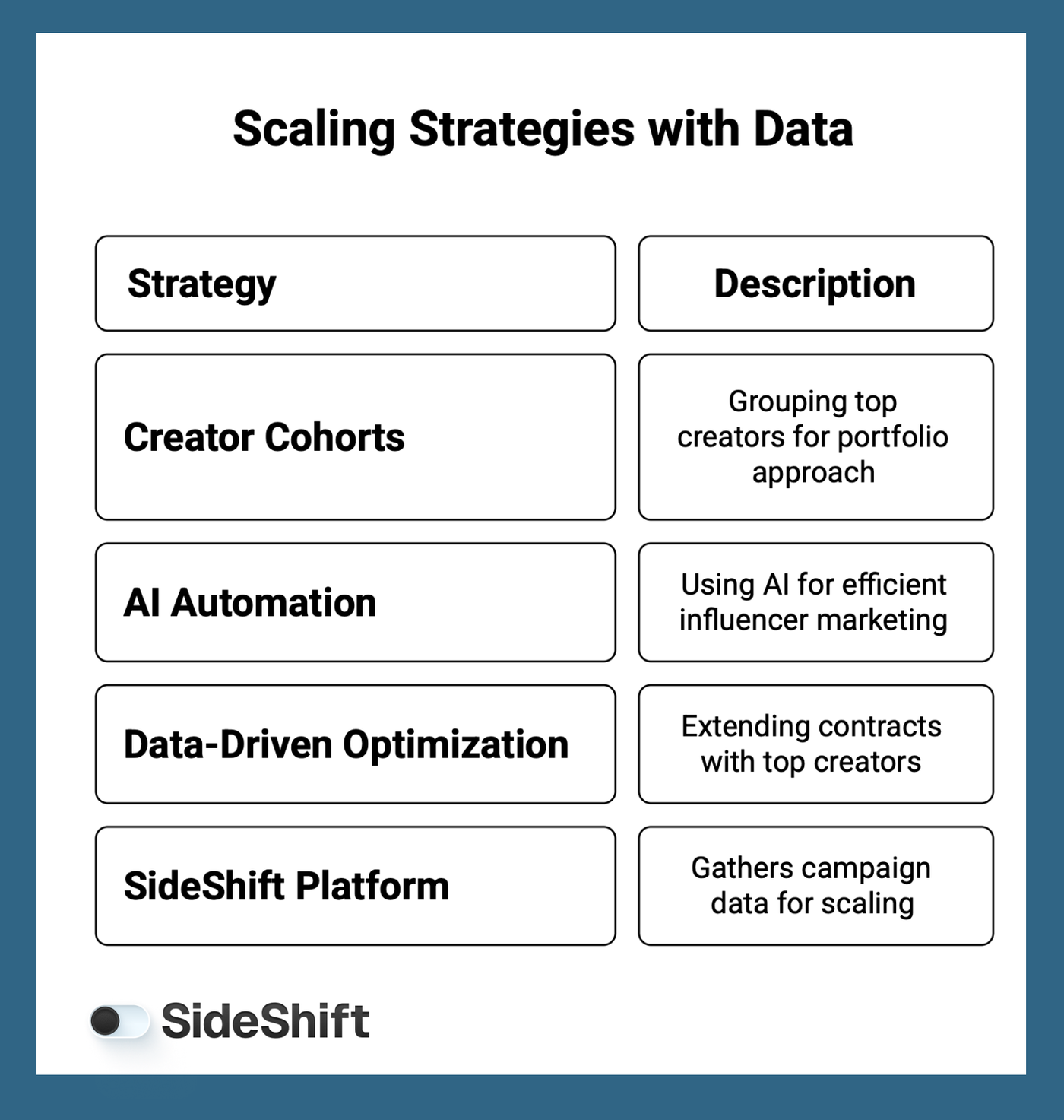
Your data can identify top-performing creators and formats, which you can then group into “creator cohorts.” This is a portfolio approach to influencer marketing. It spreads risk, adds variety to creative techniques, and makes reporting easier. Though AI can now make this process a bit more efficient. Modern AI influencer marketing tools analyze engagement patterns, forecast post performance, and even suggest the best times to post. Brands that use automation spend less time crunching numbers, and more time strategizing.
Let’s use a fashion brand as an example. Let’s say this brand works with creators and is running 50 videos. After two weeks, data shows that the top 10% of creators are responsible for 60% of all engagement. The brand extends contracts with those producers, tries out fresh copy or captions, and retargets the videos as paid ads, which doubles the return on ad spend.
SideShift makes this process seamles by gathering campaign data, showing marketers what works, and helping them scale winning formats and creators. To learn more about how to find the ideal creator tiers, read "What Is a Micro Influencer?" to find out why nano or micro influencers frequently convert better than celebrities (or rather macro influencers).
Budgeting for Optimized Influencer Campaigns
Planning a budget is also part of true optimization. Brands should set aside between 10–20 percent of their entire influencer spending for testing and making changes. This gives you the freedom to change the direction of your creative work, amplify winning content, or add new partners during the campaign.
Retainer structures with authors that have a good track record can also help you save money over time. Instead of always looking for new partners, keep a solid list of brand-aligned partners whose content and audience data you already trust. The consequence is reduced variation, more predictability, and a higher total return on investment.
Want to put this into practice?
SideShift connects you with vetted UGC creators who actually deliver. Start your free trial and post your first job in under 10 minutes.
Mistakes That Hurt Influencer Campaign Performance
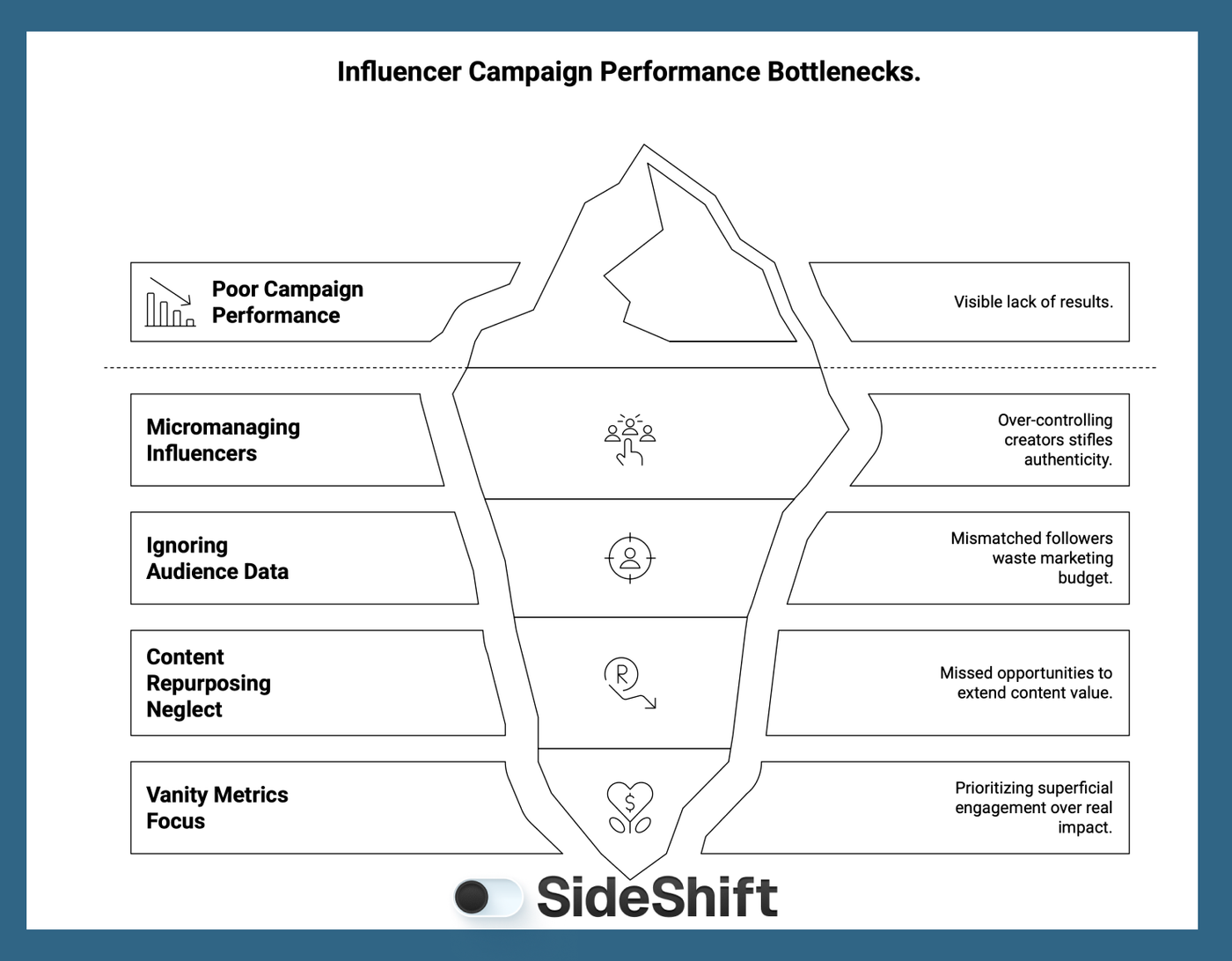
Even the most experienced marketers make mistakes that hurt performance without their knowing it. These aren't faults that new people do; they're optimization bottlenecks that stop your influencer strategy from getting better.
Treating influencers as ad inventory
When businesses write too much or micromanage authors, the message sounds more like an ad than a recommendation. Influencer marketing only works when the relationship is true. Let creators do what they do best: talk to their audience. Your duty is to agree on goals, not tell everyone what to say.
Ignoring audience data
If a creator's style fits your brand flawlessly, but their followers don't match your target buyer, you're squandering money. Real optimization starts with matching not just the style of the material, but also the demographics, psychographics, and engagement behavior of the audience. Comment sections are a great way to gauge audience sentiment.
Not repurposing content
Real creative work can be found in influencer material. You are leaving money on the table if you merely post it once and then move on. Use high-performing clips in sponsored advertising, email content, or UGC compilations. Make things that have already worked last longer.
Using vanity metrics
It's nice to have likes and comments, but they don't pay the bills. Pay attention to how well your business does downstream, like saves, shares, click-throughs, and conversions. Create a system that links what creators do to real results.
At its most basic level, optimization is a process that happens again and over again. Every campaign should use the data from the last one to plan the next one. If you don't track, test, and improve, you start from ground zero with every new collaboration. The finest influencer programs build on what they learn over time, turning each collaboration into a system that can be scaled up.
The Future of Influencer Campaign Optimization
Optimization is just as much about working together with an influencer as it is about understanding the data. Brands want openness and transparency in their campaigns, just as much as creators want to have autonomy in creating. The future will have both by sharing dashboards, automating reports, and smart contracts.
The distinctions between UGC and influencer marketing are somewhat blurred. Now, creators can be multi-platform storytellers to provide reusable content for ads, websites, and product pages.
AI will also continue to develop influencer marketing, as predictive models will find content creators with high-potential output before the campaign even begins. Recommendation engines can also use past data to make better, and optimized, content briefs.
EBut, even though AI is a part of the workflow as a marketer, the most important part of an influencer campaign is connecting real voices and stories that people can relate to.
Start Optimizing Influencer Campaigns with SideShift
Want to put this into practice?
SideShift connects you with vetted UGC creators who actually deliver. Start your free trial and post your first job in under 10 minutes.
The first step to real optimization is making sure that your brand's strategy and a creator's creative voice are in sync. When both sides are on the same page, campaigns don't just get people to click; they also make enduring bonds.
SideShift makes that alignment easy. Find trusted Gen Z creators, keep track of your partnerships, automate contracts and payments, and keep an eye on performance in real time, all from one place.
Start optimizing your next influencer campaign using SideShift.