
Food Influencer Marketing for Restaurants & Brands
UGC and creator content now influence more food purchases than traditional ads. Here's how brands are structuring partnerships that actually drive sales.
Table of Contents
Food Influencer Marketing: Strategies for Restaurants and E-commerce Brands
Phone eats first.
It sounds like a joke, but this cultural shift toward creating and sharing food content on social media changed how people discover and choose restaurants and food brands everyday.
Nearly 74% of customers use social media to decide where and what to eat, and 22% return to restaurants because of its social media presence. Those two numbers cover a significant portion of your customer journey from acquisition to retention, and neither of them requires you to run a single ad. What they do require is content.
Specifically, the kind that people actually trust. The problem is that most branded content doesn't gain that trust automatically. You can post beautiful photos of your food every day and still feel like you're talking to yourself.
When a creator your audience already follows films themselves trying your dish, visiting your restaurant, or adding your product to a recipe they actually make, that recommendation carries weight that a polished, brand-owned post simply doesn't. Food influencer marketing works because it taps into the same word-of-mouth dynamic that has always driven food decisions. It's just happening on TikTok and Instagram instead of a group chat.
For restaurants, that might mean working with a local micro-influencer whose followers actually live nearby. For food e-commerce brands, it might mean a steady stream of UGC that outperforms your studio creative in paid ads. The mechanics look different depending on your business, but the underlying principle is the same: the right creator, talking to the right audience, is one of the more cost-effective ways to grow a food brand right now.
What Makes Food Influencer Marketing Different From Other Categories?
Food is visceral in a way that most product categories simply aren't.
Studies dating back to 2012, in the early days of Instagram, showed that looking at a picture of food is enough to trigger a spike in ghrelin (the hormone that signals hunger). Your body responds to a photo of a burger the same way it responds to actually smelling one. No other product category has that kind of direct line to a physical response.
A skincare brand can describe results. A software brand can show dashboards. A food brand can make you feel the desire for the crunch, the heat, and the melt before you've even decided you're hungry.
That's what makes food content so shareable, and what makes food influencer marketing so effective when it's done well. A creator filming their honest reaction to a dish with the steam rising, or with the pull of melted cheese, or the sound of a proper crust breaking, triggers something involuntary in the viewer.
Types of Food Influencers to Know Before You Start
Before you reach out to a single creator, get clear on what you're looking for. There are a few categories worth distinguishing:
Niche food creators
These creators focus on a specific cuisine, diet, or format (such as gluten-free baking, NYC restaurant reviews, or weeknight dinners) and tend to build highly targeted, loyal audiences.
Want to put this into practice?
SideShift connects you with vetted UGC creators who actually deliver. Start your free trial and post your first job in under 10 minutes.
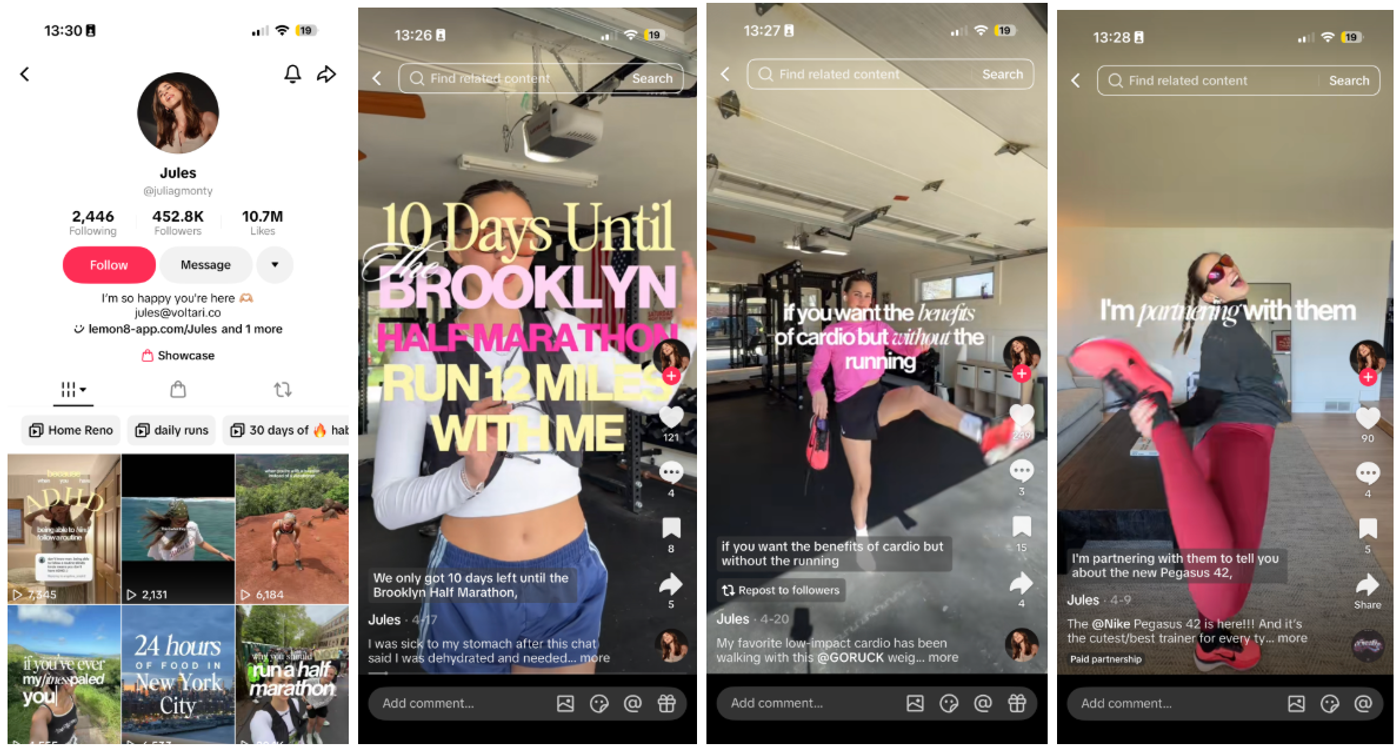
Take Lauren, a food influencer with a niche focus on gluten-free eating. She posts restaurant guides for cities across the country, helping her audience—people who navigate dietary restrictions every time they eat out—find places they can actually enjoy. She also partners with gluten-free food brands to create recipes her followers can make at home, using products she genuinely incorporates into her own diet and lifestyle.
Lauren's audience isn't massive. But it's one of the most specific, high-intent audiences in the food space. Someone following a gluten-free food and restaurant guide account isn't casually browsing. They're actively looking for recommendations they can trust.
Lifestyle creators with a food focus
These creators aren't exclusively food accounts, but eating well, cooking at home, or dining out is a consistent part of how they present their lives. Their audience follows them for who they are, which means a food recommendation lands more like a personal suggestion than a sponsored post.
They tend to work best for brand awareness and for introducing your product or restaurant to people who are not actively searching for it, but are receptive because they already trust the creator. The more specific the overlap between their world and yours, the less work the content has to do.
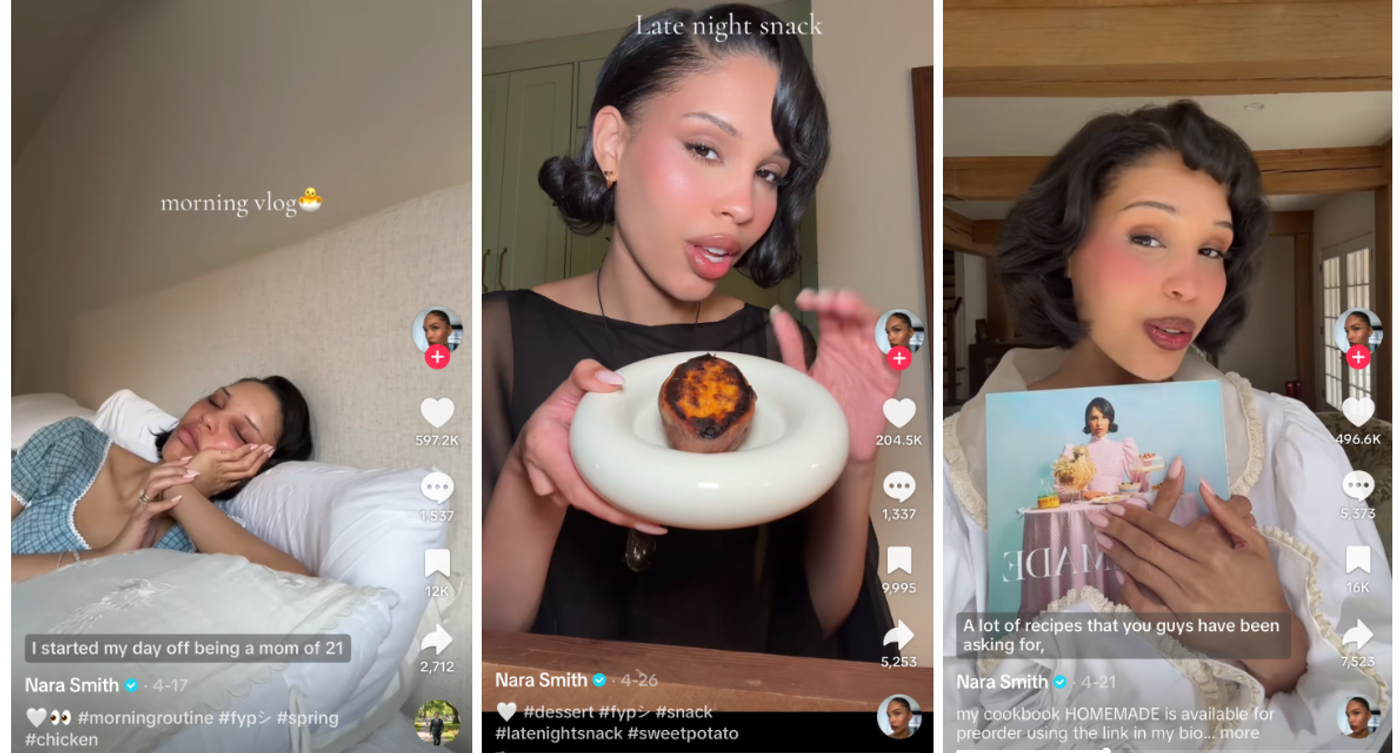
A good example of this in practice is a creator like Nara Smith, who has built a massive following around aesthetic homemaking and from-scratch cooking. She's not a food critic or a restaurant reviewer, but a lifestyle creator whose content happens in the kitchen. When a food brand shows up in her world, it feels like part of her life.
When thinking about your restaurant or food brand audience, focus on creators who already live in that same world.
UGC creators
UGC creators are not focused on growing their own following, but are skilled at producing content that performs on your channels, which makes them increasingly valuable for paid media.
Popsips, a beverage brand building out their creator program, is a good example of how UGC works in practice. Rather than chasing influencers with large followings, they've engaged creators like Antonia who aren’t focused on growing a personal audience, but know exactly how to produce content that performs. Antonia’s video is creative, native to the feed, and built to stop the scroll.
Popsips can then take that content and run it across their own channels and paid media, where it consistently outperforms anything produced in a traditional studio setting.
That's the value of a UGC creator. You're not paying for their audience. You're paying for their ability to make your brand look inconspicuous with content that feels like something a real person made because they genuinely love the product, not because they were hired to post about it. When it comes to paid ads, that kind of authentic creative is often what converts best.
Engaging UGC creators like Antonia tends to be the more cost-effective solution to content creation and influencer marketing, especially if you're looking to activate multiple creators at once. Rather than putting your entire budget behind one large influencer partnership, you can distribute it across several UGC creators, generating a higher volume of content at a lower cost per asset.
Want to put this into practice?
SideShift connects you with vetted UGC creators who actually deliver. Start your free trial and post your first job in under 10 minutes.
Viral Food Entertainers
These creators are often built on entertainment as much as expertise. If your product has a strong visual or reaction element, this is a good fit.
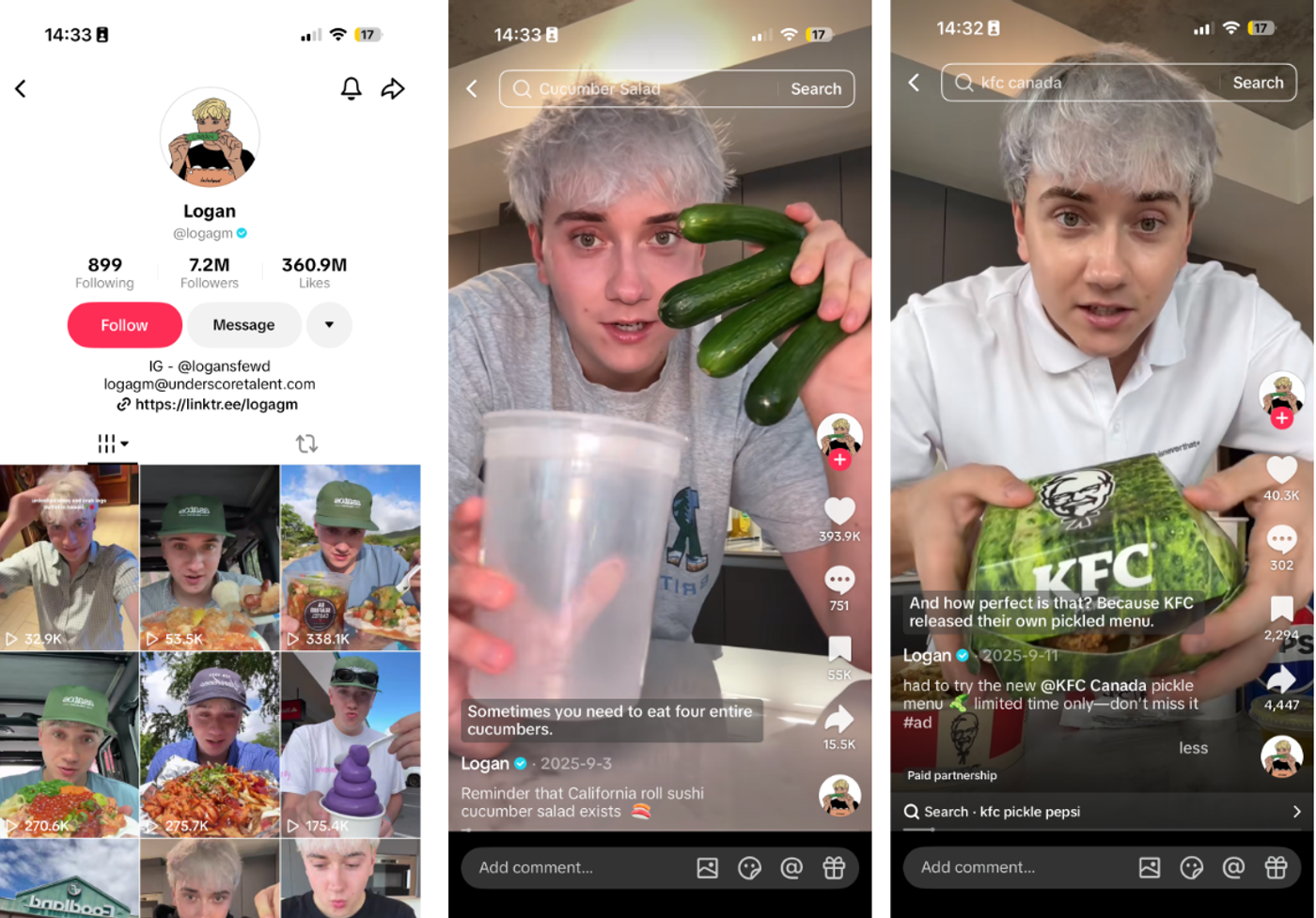
You might recognize this TikTok food influencer Logan, the cucumber guy. If you've spent any time on TikTok food content, you've probably seen him. He built a following around a very specific cucumber obsession stemming from his love of Korean and Asian cuisine. His deadpan delivery made “sometimes you need to eat a whole cucumber, let me show you the best way to do it” genuinely viral. It sounds niche to the point of absurdity, but that's exactly what made it work.
Which is why when KFC launched their limited-time pickle menu, Logan was the obvious call. The cucumber-to-pickle pipeline made complete sense, and the partnership landed naturally because it didn't feel forced. His audience trusted his taste, the product fit his world, and the content performed because it felt like something Logan would genuinely get behind.
Influencers are great for moments exactly like that, when a product, a campaign, or a limited-time launch needs to reach a specific audience fast, through a voice they already trust, in a format they actually watch.
Creators like Logan are native to TikTok, but the food entertainer archetype exists across Reels and YouTube Shorts too. The platform changes, the dynamic doesn't.
Once you know what kind of creator you're looking for, the next step is knowing how to find them, vet them, and build a partnership that actually holds.
How to Find the Right Food Content Creators for Your Brand
The search usually starts in one of three places: platforms you're already on, creator marketplaces, or your own customer base.
Scrolling hashtags related to your cuisine, location, or product category will surface creators who are making relevant content. Your own tagged posts and followers are worth checking too, as some of your best potential creators already know your brand. For a more systematic approach, creator platforms like SideShift let you filter by niche, location, and audience profile upfront rather than manually reviewing profiles one by one.
While you’re searching, don't get stuck on influencer follower count. What you're really looking for is content market fit (i.e. how well a creator's existing world maps to your brand's). When evaluating creators, check:
- Niche alignment: Does their content naturally overlap with your product, cuisine, or customer? A creator who already talks about what you sell will always outperform one who's willing to talk about anything.
- Comment quality: Are people asking where to buy, tagging friends, saying they tried it?
- Content consistency: Do they post food regularly or occasionally?
- Past brand work: Does their sponsored content feel natural or like a script?
- Audience location: This is especially critical for restaurant influencer marketing, where geography determines relevance.
Want to put this into practice?
SideShift connects you with vetted UGC creators who actually deliver. Start your free trial and post your first job in under 10 minutes.
In practice, working through all of that manually across dozens of potential creators takes time most brands don't have. Sideshift simplifies that process by giving restaurants and food brands access to a vetted network of creators, filtered by niche, audience location, content format, and past performance, so you're spending time building relationships with the right people rather than sorting through profiles to find them.
Influencer Marketing Strategies for Restaurants
For restaurants, the goal is usually foot traffic, social proof, or local awareness. Your influencer strategy should map directly to whichever one you're prioritizing.
- Driving foot traffic works best with micro-influencers in your city or neighborhood. A food blogger with 12,000 local followers can fill your Tuesday dining room faster than a national campaign. Invite them in, give them a real experience, and let them create. Over-directing the content removes the authenticity that makes it work.
- Building social proof is about volume and consistency over time. You want multiple creators covering your restaurant across a rolling window, not one big feature. When someone searches your name and finds 15 pieces of creator content from the last 90 days, that builds credibility in a way a single press mention can't replicate.
- Local awareness is where TikTok food influencers tend to perform well. A video from a creator with strong local reach can introduce your restaurant to thousands of people who've never heard of you. The algorithm handles distribution. Your job is to make the experience worth filming. There are also local visit pages like @visitaustin, @visitmiami, @visitcharlotte that feature businesses, restaurants, and experiences worth knowing about in a given city.
These accounts have built highly engaged local followings of people who are actively looking for things to do and places to eat in their area. You don't need a massive budget to get on their radar. A well-timed outreach, a compelling experience, or even a simple tag can get your restaurant in front of exactly the kind of local audience that turns into regular customers.
UGC Strategies for E-Commerce Food Brands
For food e-commerce brands, user-generated content is often the more cost-effective solution in your paid media rotation.
Platform algorithms on Meta and TikTok are trained to reward content that keeps people on the platform. Native-looking content does that better than polished ads, which people have learned to scroll past in under a second feeling fatigued by ads. A UGC video of someone unboxing your hot sauce subscription, tasting it over the sink, and giving an honest reaction tends to outperform a studio-produced ad. Not because the production is better. Because it reads as real. And real content holds attention.
There's also a trust element that's hard to manufacture. When a real person films themselves genuinely reacting to your product without a script, it carries the same social weight as a recommendation from a friend. That's the thing a studio ad can never replicate no matter how good it looks.
For most food e-commerce brands, a UGC program that actually produces results is built around a few different content strategies:
Want to put this into practice?
SideShift connects you with vetted UGC creators who actually deliver. Start your free trial and post your first job in under 10 minutes.
- Seed product to micro-creators and UGC specialists. Aim for 10 to 20 pieces of content per month rather than betting on one viral moment. The goal is to generate enough content that patterns start to emerge—which formats your audience responds to, which hooks stop the scroll, which products photograph and film better than others.
- License the best-performing organic content for paid amplification. When a piece of UGC performs well organically, that's your signal to put spend behind it. The audience has already told you it works. Licensing that content for paid media is almost always cheaper than producing new creative, and it typically outperforms anything made specifically for an ad.
- Test multiple hooks and formats, such as unboxing, taste reactions, recipe integrations, and “what I eat in a day” inclusions. Different formats reach people at different points in the decision process. A taste reaction might drive immediate purchase intent. A recipe integration builds longer-term brand association. Running both tells you a lot about how your audience actually engages with your product.
- Repurpose across channels. For instance, TikTok, Reels, Meta ads, email, and product detail pages. A single piece of strong UGC can do work in six different places. A video that started as an organic TikTok can become a Meta ad, an email header, a homepage feature, and a product page asset. That kind of mileage is what makes UGC so cost-effective relative to traditional content production.
The more content you're testing, the faster you find out what actually resonates with your audience. One UGC video is an experiment, but twenty is a data set. The brands that treat UGC as an always-on content engine rather than a one-time campaign are the ones more likely to find creative that scales in paid media.
That volume also gives you a library of authentic content that lives across every customer touchpoint. Sideshift is built for this kind of program helping restaurants and food and beverage e-commerce brands find vetted creators, manage briefs and deliverables, and build the kind of always-on UGC engine that actually feeds their paid media.
How to Work With Food Influencers Long-Term
A common mistake brands make is treating influencer partnerships as one-off transactions. You send product or invite them to your restaurant for a comped meal, they post, and you move on hoping something sticks.
Repeated presence is credibility. A creator who talks about your brand in March, again in June, and again in September has made your brand a normal part of their world. Their audience stops seeing it as sponsored content and starts seeing it as a genuine preference. That's the shift you're building toward.
Partnerships that hold up over time tend to share a few structural elements:
- Clear briefs with loose creative control: Tell creators what you want them to communicate, like the product benefit, the occasion, or the intended feeling, but don't script the video. Creators know their audience better than you do. The moment content sounds like an ad read, engagement drops and their audience notices. Your job is to give them the right context, not the right words.
Want to put this into practice?
SideShift connects you with vetted UGC creators who actually deliver. Start your free trial and post your first job in under 10 minutes.
- Longer commitments: A three or six month partnership with defined deliverables tends to produce better content and better results than a one-off. Creators invest more when they know the relationship has continuity, and their audience builds a genuine association with your brand over time.
- Performance-aligned incentives: Affiliate codes and commission structures align creators' financial incentives with your actual business outcomes and give you real data on which creators drive purchases rather than just impressions. That data is worth as much as the sales themselves, it tells you exactly where to concentrate your budget.
- Usage rights: If you plan to run paid media, make sure your agreements include the right to use content in ads from the start. This is one of the more frequently overlooked elements in early influencer deals and becomes a friction point later when you want to amplify content a creator technically still owns.
- Fair compensation: Gifting works for very small micro-creators who are still building their audience and value exposure. Once you're working with creators who have built a real, engaged following, expect to pay a fee. While there is flexibility depending on the creator, those who are treated as professional collaborators consistently produce better content, stay in partnerships longer, and become genuine advocates rather than just another deal in their inbox. That difference shows up in the content, and their audience can feel it.
If you're looking for a long term brand advocate or some kind of brand ambassador, start searching for champions in your own consumer base first. Some of the best creator partnerships start with someone who is already a fan, a regular customer, a frequent tagger, or someone who has been posting about your restaurant or product without being asked.
Those partnerships tend to produce the most authentic content because the enthusiasm is already there. Search your own consumer base for people who are already championing what you do. A creator who genuinely loves your brand before the deal starts is worth more than one who discovered you through a pitch deck.
Scale Your Food Influencer Program With Sideshift
For food brands and restaurants trying to cut through the slow, inconsistent process of finding and managing creator partnerships, Sideshift streamlines the entire operation. Instead of spending weeks searching hashtags, vetting profiles, and DMing creators individually, Sideshift connects you with a network of over 800,000 creators, including the food-native content creators your audience already trusts.
For restaurants, CPG food brands, and food e-commerce companies, the ability to recruit food content creators at scale but also filter by location means you can finally run the kind of multi-creator, high-volume UGC strategy that outperforms traditional ad creative. You can manage briefs, contracts, content review, and payouts inside a single platform, cutting the operational overhead that makes influencer programs difficult to sustain.
Want to put this into practice?
SideShift connects you with vetted UGC creators who actually deliver. Start your free trial and post your first job in under 10 minutes.
FAQs
1. How many followers does a food influencer need to be worth working with?
There's no meaningful minimum. A creator with 5,000 highly engaged local followers can drive more restaurant reservations than one with 500,000 passive ones. Evaluate engagement rate, audience location, and content quality before follower count.
2. What's the difference between influencer marketing and UGC for food brands?
Influencer marketing is primarily about distribution—using a creator's audience to reach new people. UGC is primarily about content production—creating authentic-looking assets you can use in your own channels and paid ads. Many food brands benefit from both, and some creators serve both functions.
3. How do you measure ROI on food influencer campaigns?
Use a combination of tracked promo codes, affiliate links, UTM parameters on linked content, and platform analytics for reach and engagement. For restaurants, ask new customers how they heard about you and track changes in reservation volume or foot traffic during campaign windows.
4. Should restaurants pay food influencers or just offer free meals?
For nano-creators and food bloggers building their audience, a gifted experience is often acceptable. For creators with established audiences and professional content quality, expect to pay a fee in addition to the experience. Undervaluing creator work consistently produces lower-quality content and weaker long-term relationships.
5. How often should a food brand post influencer or UGC content?
For e-commerce brands running paid media, treat UGC as an always-on creative source with new content coming in weekly. For organic social, three to five creator-sourced posts per week builds a strong social proof signal without overwhelming your feed.