
Fitness Influencer Marketing Guide for Brands
Workout content gets saved, shared, and acted on more than almost any other niche. Here's how brands are capitalizing on fitness influencer marketing.
Table of Contents
Fitness Influencer Marketing Guide for Gyms and Fitness Brands
Fifty-nine percent of consumers find fitness and exercise content from influencers useful, ranking it second only to travel, according to a YouGov Surveys poll spanning 17 international markets. For context, fashion and food did not crack the top two. Fitness did.
Fitness is a lifestyle category, which means it bleeds into every other vertical. The fitness creator who posts a 6 a.m. workout also talks about sleep, nutrition, mental health, recovery gear, activewear, travel, and how they structure their day. Their audience is watching because they want to live more like that person. That kind of sustained aspiration and habitual relevance is what makes fitness influencer marketing different from almost every other category.
For gyms and fitness brands, this matters because you’re not just selling a product or a class. You’re selling an ideal version of someone's life. Creators who genuinely embody that—who actually train the way they post and live the habits they talk about—carry real authority with their audience. That authority translates to action in a way that a sponsored post for a new flavor of sparkling water simply does not.
This guide walks you through exactly how to build a fitness influencer marketing strategy that converts: how to find the right creators, how to run a campaign, and how to know whether it's working.
Why Does Fitness Influencer Marketing Work Differently Than Other Niches?
A fitness creator posts everything from workouts, what they eat, what they wear, how they sleep, how they manage stress, and what gear they use to recover. Their content touches nutrition, fashion, wellness, mental health, travel, and daily routine, sometimes all in the same week, maybe even in the same video. That makes them uniquely powerful for brands, because their audience is not following them for a single type of content. They are following them for a way of living.
Compare that to a food influencer, whose audience shows up for recipes, or a fashion influencer, whose audience shows up for outfit ideas. Those are real audiences with real purchasing intent, but the relationship is narrower. When a fitness creator recommends your gym, your app, or your supplement, it lands inside a much broader context of trust that their audience has built with them over months or years of watching them actually do the thing.
That consistency is what separates fitness from other niches. A fashion creator can post about a brand once and move on. In fitness, the creators who perform best for brand partners are the ones whose audience has seen them show up, day after day, living the life they talk about. When someone like that mentions your gym, it does not feel like an ad. It feels like a referral from someone their audience actually respects.
For gyms specifically, that dynamic is worth understanding in practical terms. You are not selling a one-time product. You are asking someone to change their routine, commit to a space, and spend money on it month after month. That is a much higher bar than convincing someone to buy a new snack or try a new lipstick. Routine, habit, and long term goals matter most in the fitness niche.
Want to put this into practice?
SideShift connects you with vetted UGC creators who actually deliver. Start your free trial and post your first job in under 10 minutes.
How Do You Find the Right Fitness Content Creators?
Follower count is the wrong starting point. A creator with 35,000 followers who posts exclusively about powerlifting will outperform for your gym or fitness brand over one with 800,000 followers in a general lifestyle niche, because their audience showed up specifically for fitness content and actually acts on it.
Here’s a step-by-step process for finding creators who will actually resonate with your ideal audience.
Step 1: Define What “Right” Looks Like
Before you open any platform or tool, get specific about what you need. Ask yourself:
- What kind of fitness content are you looking for? (Powerlifting, HIIT, yoga, endurance, general wellness?)
- Which audience are you trying to reach? (Age range, training style, geography)
- Which platform does that audience spend the most time on?
- Do you need local reach or national reach?
- Are you looking for brand awareness, direct sign-ups, or UGC content you can repurpose?
A gym looking to drive local memberships has completely different criteria than a supplement brand running a national campaign. Locking in your answers here saves you hours of evaluating the wrong people.
Step 2: Search with Filters, Not Just Hashtags
Hashtag browsing on Instagram or TikTok can get you started, but it does not scale. For a more targeted search, use a creator marketplace platform like SideShift to filter fitness content creators by niche, platform, location, and audience demographics. For gyms especially, local filtering matters more than most brands realize. A creator with 2,000 followers in your city is worth more than one with 200,000 followers three states away.
Step 3: Look Past the Follower Count
Once you have a shortlist, these are the signals that actually predict performance:
- Engagement rate: Aim for 3% to 6% on Instagram and higher on TikTok. For YouTube creators, view-through rate and comment quality tell you more than likes.
- Comment quality: Are people asking real questions and sharing personal experiences, or just posting fire emojis?
- Content consistency: Are they posting regularly, or only when a brand pays them?
- Audience alignment: Does their audience actually train, or just consume fitness content passively?
Step 4: Vet Their Content History
Scroll back at least 60 to 90 days. You want to know how many brand deals they have run recently, whether those posts performed as well as their organic content, and whether the brands they have worked with are complementary or competitive to yours. A creator who posts three sponsored pieces a week has an audience that tunes out ads. You want someone whose paid partnerships still feel like their own voice.
Step 5: Reach Out Like a Human
Skip the generic DM template. Reference a specific piece of content, explain why there’s a genuine fit, and lead with what’s in it for them, not what you need. Creators receive a lot of pitches, so a short, specific, human message will outperform a polished pitch deck almost every time.
Want to put this into practice?
SideShift connects you with vetted UGC creators who actually deliver. Start your free trial and post your first job in under 10 minutes.
Consider Matching with Fitness Influencers on SideShift
All five of these steps can be done manually, and many brands start that way. But if you’re running more than a handful of creator partnerships at a time, the process gets unwieldy fast.
SideShift handles the heavy lifting across every stage, from vetting and outreach to briefs, payments, and performance tracking, so creators can find and apply to your campaigns directly. Instead of chasing down influencers one DM at a time, you build a program that brings the right ones to you.
What Does a Strong Fitness Influencer Campaign Look Like?
If you're figuring out how to work with fitness influencers, the best campaigns share a few things in common: they give creators room to be themselves, are tied to a real moment or goal, and are built specifically for the platform they’re on.
UGC for Fitness Brands
User-generated content is one of the most efficient formats for fitness brands. For gyms and supplement brands, this means clearly briefing creators, letting them film in their natural environment, and repurposing that content across your own channels.
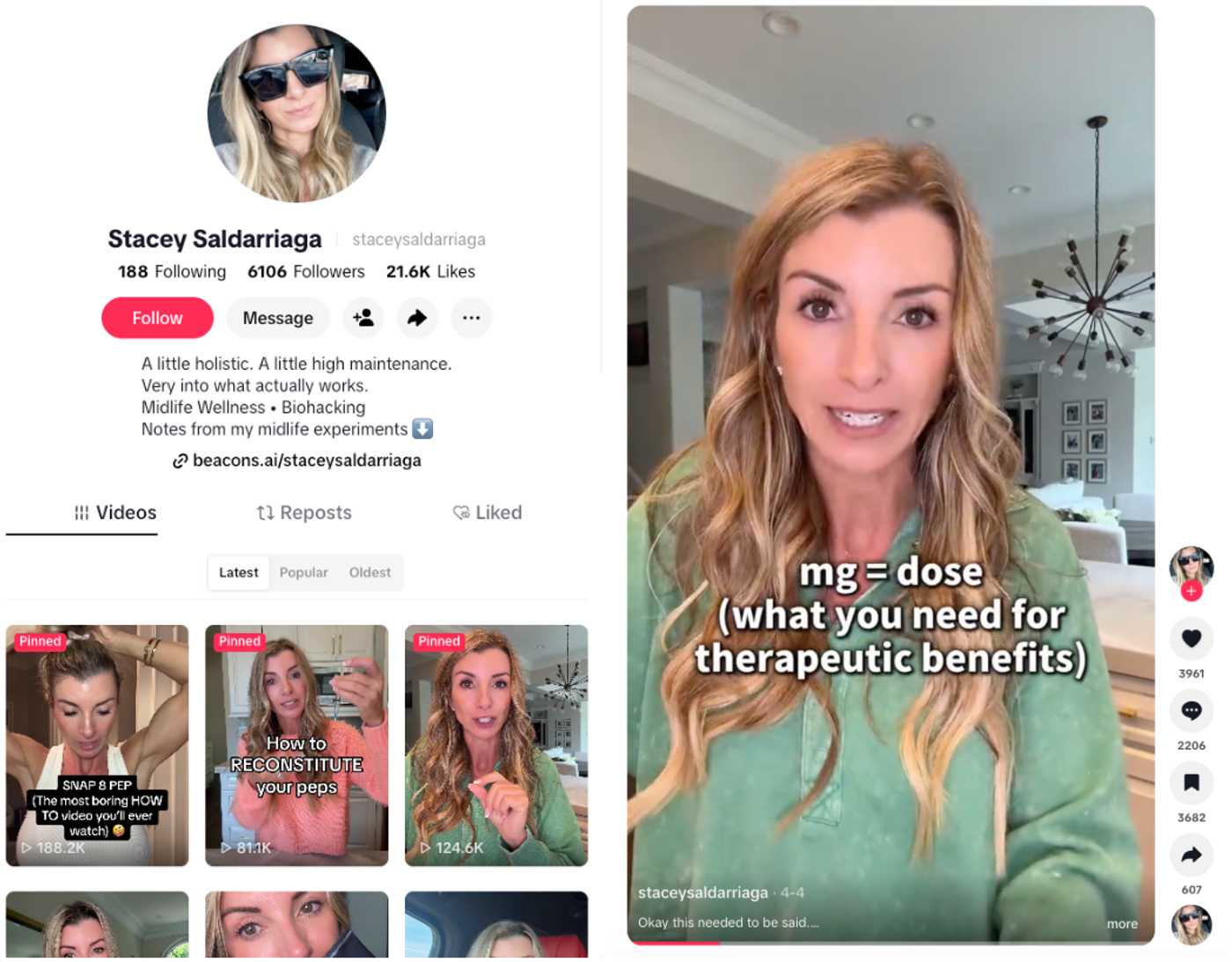
Stacey Saldarriaga has under 10,000 followers. She is not a macro influencer by any metric. But when a peptide tracker app posted a content brief calling for UGC creators in the health and wellness space on SideShift, she applied, got the partnership, and now creates content for them regularly while getting paid to do it.
This is one version of a successful fitness influencer campaign. Not the biggest name, not the largest budget. The right brief, in front of the right creators, producing content that actually fits the brand.
TikTok Fitness Influencers
TikTok rewards authenticity. Fitness content that performs tends to be quick, specific, and educational—like a 45-second form tip, a gym bag check, or a “what I eat before a 6 a.m. workout” video. If you’re partnering with TikTok fitness influencers, give them a clear message but do not over-script it. The more it sounds like a brand, the less it performs.
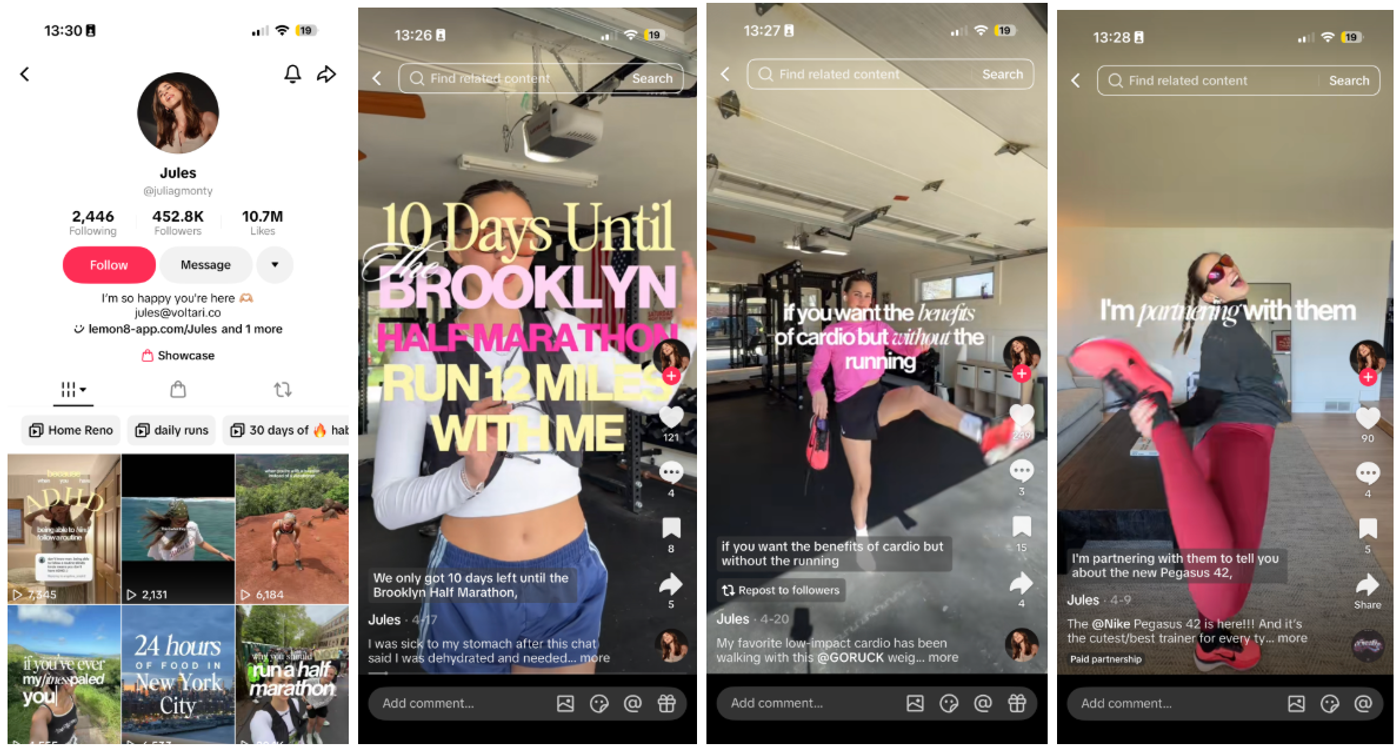
Jules is a macro influencer in the fitness space who partners with fitness brands and products regularly. Her audience expects it, trusts it, and engages with it because her entire platform is built around fitness. The brand partnerships feel like a natural extension of her content, not an interruption of it.
YouTube and Long-Form Content
For gyms selling memberships or premium fitness brands like Equinox, YouTube collaborations drive a different kind of result. A 10-minute gym tour or a “I trained at [gym] for 30 days” video generates compounding search traffic. These partnerships take longer to produce, but have a much longer shelf life than a TikTok or Story. Long-form content can also be repurposed as short-form content across social media channels for even more reach.
How Do You Know If Your Fitness Influencer Marketing Is Working?
This question trips up a lot of brands because they’re measuring the wrong things. Vanity metrics like likes, reach, and follower growth feel good but don’t tell you much about actual business impact.
Want to put this into practice?
SideShift connects you with vetted UGC creators who actually deliver. Start your free trial and post your first job in under 10 minutes.
When it comes to influencer marketing for gyms and fitness brands, the metrics worth tracking include:
- Promo code redemptions tied to specific creators
- Traffic from creator-specific UTM links
- New membership or trial sign-ups during campaign windows
- Branded search volume lift (track with Google Search Console)
- Retargeting conversion rates from audiences exposed to creator content
Platforms like SideShift consolidate campaign performance data so you’re not manually pulling reports from five different dashboards. For fitness brands running campaigns across Instagram, TikTok, and YouTube simultaneously, that kind of visibility is what separates a manageable program from a chaotic one.
Ready to Build a Fitness Creator Partnership Program That Actually Converts?
If you've been burning budget on paid ads with shrinking returns, or you've worked with influencers before but had no way to tell whether they actually drove sign-ups or sales, the issue usually isn't creator marketing itself, it's running campaigns without the infrastructure to make them work.
You don't need a massive influencer budget to make creator marketing work for your gym or fitness brand. You need the right creators, a clear brief, and a consistent way to measure whether it drove results.
SideShift is built to help fitness brands do exactly that, from creator discovery and outreach to campaign tracking, creator payouts, and performance reporting. See how it works and start building creator partnerships that actually align with your message and boost your bottom line.
FAQs
1. How much does fitness influencer marketing typically cost?
Pricing varies widely by platform, follower count, and content format. Micro-influencers (10,000 to 100,000 followers) typically charge between $200 and $2,000 per post, while mid-tier creators (100,000 to 500,000) may range from $2,000 to $10,000. Many gyms start with gifted memberships or product exchanges before moving to paid partnerships. The key is tying compensation to deliverables and measuring actual ROI, not just reach.
2. What is the difference between micro and macro fitness influencers, and which is better for gyms?
Macro influencers (500,000+ followers) deliver broader awareness but often have lower engagement rates and higher costs. Micro-influencers (10,000 to 100,000 followers) tend to have more niche, loyal audiences and stronger trust, which matters a lot for gyms targeting a local or regional audience. For most gyms, a mix of several micro-influencers outperforms one expensive macro deal.
3. How do you find fitness influencers in your local area?
Start with hashtag searches on Instagram and TikTok using your city or region plus fitness terms (#[city]fitness, #[city]gym). On YouTube, search your city plus fitness and sort by recently uploaded. Look for creators tagging local venues and check who your current members follow. Dedicated creator platforms with location filtering, like SideShift, make this process significantly faster and more targeted.
4. What should you include in a fitness influencer brief?
A strong brief covers the campaign goal (awareness, sign-ups, product trial), the key message you want communicated, required disclosures (FTC compliance), content deliverables and timeline, usage rights for repurposing content, and any brand guidelines around tone or visual style. Keep it concise. One page is usually enough. Leave room for the creator's voice.
Want to put this into practice?
SideShift connects you with vetted UGC creators who actually deliver. Start your free trial and post your first job in under 10 minutes.
5. How do you measure ROI from a fitness influencer campaign?
The most reliable methods are creator-specific promo codes, unique UTM links for tracking traffic, and direct attribution from sign-ups or purchases during the campaign window. Pair that with Google Search Console data to track branded search volume lift. Over time, building a simple tracking spreadsheet for each campaign lets you compare performance across creators and platforms and refine your approach.
6. What do fitness influencers promote?
Fitness influencers typically promote supplements and nutrition products, workout equipment, gyms and apparel, fitness apps and training programs, and wellness brands, covering everything from recovery tools to sleep and stress management. The most effective partnerships are usually with products the creator already uses or would genuinely recommend.