
Facebook Influencer Marketing: A Step-by-Step Guide
Facebook influencer marketing still drives real ROI in 2025. Here's how brands build campaigns that reach the right audiences and actually convert.
Table of Contents
Getting Started with Facebook Influencer Marketing Step by Step
Facebook influencer marketing is the practice of partnering with creators to reach and convert audiences through posts, Reels, Groups, Live content, or UGC running as paid ads. While Facebook doesn't get the same cultural buzz anymore as Instagram or TikTok, it quietly remains one of the highest-converting platforms in paid and organic social. With over 3 billion monthly active users and an ad ecosystem that rewards authentic content, it's a channel serious brand marketers can't afford to write off just because it's not trending in conversations.
This guide walks through exactly how to build a Facebook influencer marketing campaign from the ground up: who to work with, how to structure it, and what to measure.
Why Facebook Still Deserves a Place in Your Influencer Strategy
The narrative that Facebook is a dying platform is mostly a Gen Z opinion, not a media buyer's reality. The 25-34 age bracket makes up the biggest chunk of its user base, skewing only slightly older than TikTok or Instagram, but not by much. This is actually a significant advantage for brands targeting millennials, Gen X, and baby boomers with real purchasing power.
E-commerce brands, home goods, financial services, health and wellness, and SaaS companies consistently find strong ROI on Facebook because the audience is there and they buy. Facebook's algorithm has also matured in ways that benefit creator-driven content.
Video content, particularly short-form Reels, now receives significant organic distribution. At the same time, Facebook's ad system allows brands to whitelist creator content and run it as paid social directly from the creator's account. This combination of organic reach potential and paid amplification makes Facebook a uniquely flexible channel for influencer and UGC campaigns.
The brands that underperform on Facebook are usually the ones applying an Instagram playbook without adjusting for the platform's different audience behavior, content formats, and community dynamics. Facebook users engage differently: they share content to Groups, comment in longer threads, and respond well to content that feels conversational rather than aspirational.
Understanding the Facebook Creator Landscape
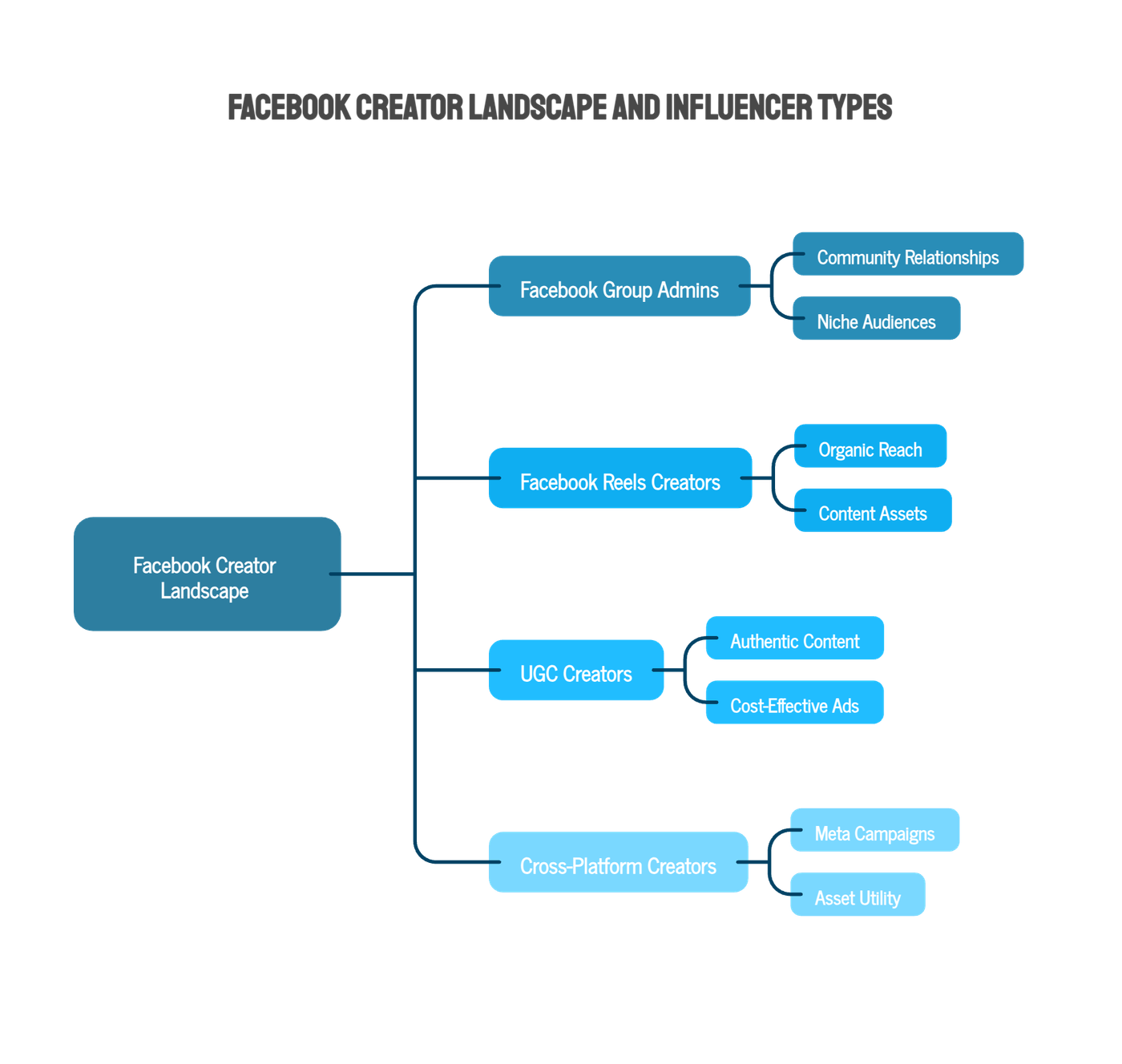
Facebook's creator ecosystem is less talked about than Instagram's, but it's substantial. The platform supports a wide range of content formats and creator types, each with different strengths depending on your campaign goals.
Facebook Group Admins and Community Leaders
This is one of Facebook's most underutilized influencer categories. Group admins often command highly engaged, niche audiences built around specific interests, and their recommendations carry significant trust because they've built real community relationships. A post or recommendation from a trusted Group admin can often outperform a macro-influencer post by a significant margin in conversion rate.
Facebook Reels Creators
Short-form video has become central to Facebook's feed algorithm. Creators who produce native Reels content for Facebook bring both organic reach and content assets that can be repurposed in Meta's paid ad system. This dual utility makes them especially valuable for brands running integrated organic and paid strategies.
UGC Creators for Facebook Ads
This category deserves its own callout. UGC creators don't post to their own Facebook feeds. They produce authentic, creator-style video content that brands own and run through their own paid campaigns. On Facebook, where ad fatigue is real and polished creative underperforms authentic content, UGC has become one of the most cost-effective ways to generate top-performing ad assets at scale.
Want to put this into practice?
SideShift connects you with vetted UGC creators who actually deliver. Start your free trial and post your first job in under 10 minutes.
Cross-Platform Creators
Many creators operate across Facebook, Instagram, and TikTok simultaneously. For brands running Meta campaigns, working with creators who can produce content natively for both Facebook and Instagram often maximizes asset utility and reduces per-unit production cost.
How to Build a Facebook Influencer Campaign Step by Step
If you're figuring out how to start influencer marketing on Facebook, the process is more structured and repeatable than most brands expect. These five steps walk you through everything from setting your objective to measuring what actually worked.
Step 1: Anchor the Campaign to a Specific Business Goal
Facebook influencer marketing can serve awareness, consideration, or conversion objectives, but campaigns that try to do all three at once rarely do any of them well. Before you brief a single creator, lock in your primary goal.
- Awareness: You want reach, impressions, and brand recall. Broader creator partnerships and Group-based content tend to perform here.
- Consideration: You want engagement, video views, and content saves. Mid-tier creators with highly engaged communities are your lever.
- Conversion: You want clicks, sign-ups, and purchases. UGC content running as paid ads with strong calls to action consistently outperforms traditional creative for this objective on Facebook.
Step 2: Map Your Audience to the Right Creator Type
Facebook's audience segmentation is one of its greatest strengths. Before choosing creators, get specific about who you're trying to reach.
Start by answering a few key questions:
- What age range and life stage does your core customer fall into?
- What interest categories, communities, or Groups does your audience participate in?
- Is your audience more likely to engage with educational content, entertainment, or community-driven conversation?
- Are you targeting cold audiences or retargeting warm ones?
The answers directly inform whether you should be working with Group admins, Reels creators, UGC specialists, or some combination of all three.
Before making that decision, it's worth pulling up Meta's Audience Insights tool available inside Meta Business Suite and Ads Manager. It surfaces demographic, interest, and behavioral data about the people already engaging with your page or ads, giving you a data-backed baseline for the questions above.
Step 3: Source and Vet Creators
Figuring out how to find Facebook influencers for your brand is often harder than finding Instagram talent, largely because Facebook's native creator discovery tools are less developed. Brands typically rely on one of three approaches:
- Manual search: Facebook's search function, Group directories, and hashtag exploration can help find creators organically, but the process is time-intensive and inconsistent.
- Agency or influencer database: This approach provides volume but often lacks Facebook-specific filtering and quality control.
- Creator marketplace: Platforms like SideShift give brands access to pre-vetted creator networks with built-in tools for recruitment, contracting, and payouts, cutting the sourcing timeline dramatically.
Want to put this into practice?
SideShift connects you with vetted UGC creators who actually deliver. Start your free trial and post your first job in under 10 minutes.
When evaluating any Facebook creator, look beyond follower count. Prioritize:
- Engagement rate, comment quality, and shares: Generic reactions tell you nothing. Substantive comments signal a real audience, while high share counts suggest content worth redistributing.
- Content style alignment: Does their existing content feel native to Facebook, or are they clearly repurposing from other platforms?
- Audience demographics: Use whatever data is available to confirm their audience matches your target customer profile.
- Posting consistency: Sporadic creators are a reliability risk. Look for creators with predictable output.
Step 4: Build a Brief That Protects Quality Without Killing Creativity
The brief is where most brand-creator relationships either succeed or break down. Overscripted briefs produce stiff content that audiences ignore. Underspecified briefs produce off-brand content that wastes the campaign budget. The goal is structured creative freedom.
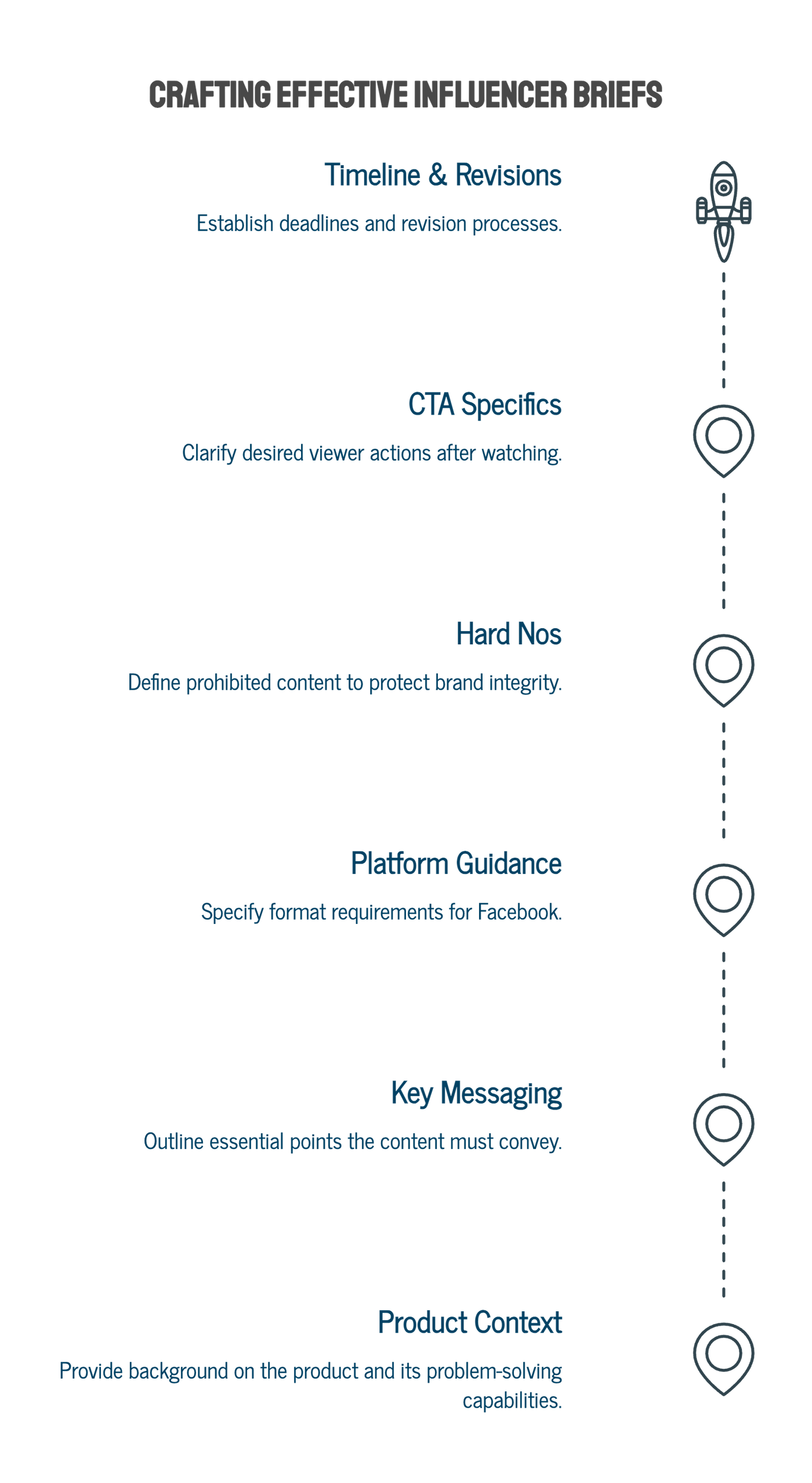
A strong Facebook influencer brief includes:
- Product and problem context: What does your product do, and what specific problem does it solve for the customer? Give the creator enough context to speak authentically.
- Must-hit messaging: Outline two to three key points you need the content to communicate. Not a script, but guardrails.
- Platform-specific format guidance: Specify things like ideal Facebook Reels length (typically 30-60 seconds), whether captions are needed for silent viewing, and any visual requirements.
- Hard nos: Clearly define what the creator absolutely should not say, show, or imply. This protects both the brand and the creator.
- CTA specifics: Clarify what you want the viewer to do after watching. Link in caption, discount code, page visit, whatever the conversion action is.
- Timeline and revision policy: Be explicit about deadlines and how many revision rounds are included.
Step 5: Amplify High-Performing Content Through Paid
This is the step that separates brands running influencer campaigns from brands running influencer-powered growth engines. When a piece of organic creator content performs well, the data is telling you something about what your audience responds to. Don't let that signal die with the organic post.
Facebook's whitelisting capability allows brands to run paid ads using the creator's account and content. This keeps the authentic, native feel of the content intact while giving it paid distribution and targeting precision. Combining organic creator content with paid amplification is one of the most efficient ways to scale what's working on Meta.
UGC vs. Traditional Facebook Influencers
For brand marketers evaluating where to allocate creator budget, this distinction has real financial implications.
Traditional Facebook influencer partnerships give you access to an audience you don't own. That reach and built-in trust can be incredibly valuable for tapping into established communities.
The tradeoff is that you pay for a post, it goes up, and if it doesn't perform, you've absorbed the loss with limited ability to optimize. The content typically belongs to the creator and can't be repurposed freely.
Facebook UGC creator campaigns work differently.
You commission content, you own it, and you can deploy it across paid ads, your organic feed, and other channels. More importantly, you can test multiple content variations simultaneously, identify what drives the strongest click-through and conversion rates, and scale the winning formats. This is the same iterative logic that drives performance marketing, applied to creator content.
Want to put this into practice?
SideShift connects you with vetted UGC creators who actually deliver. Start your free trial and post your first job in under 10 minutes.
The case for high-volume UGC on Facebook is learning speed. More creative variations in the ad system means more data, faster iteration, and a much shorter path to knowing what your audience actually responds to at a lower per-asset cost than traditional influencer marketing might offer.
Scale Your Facebook Creator Campaigns with SideShift
Building a real Facebook influencer strategy means moving past one-off partnerships and into a system of consistent creator sourcing, structured briefs, high-volume content production, and performance-driven iteration.
SideShift connects brands with over 800,000 U.S.-based Gen Z creators, with tools for job posting, creator recruitment, contracts, and payouts all in one platform. For marketing teams running Facebook campaigns, that means less time managing spreadsheets and more time analyzing what's actually performing. Plans start at $199/month for brands ready to move from ad hoc creator outreach to a scalable content operation.
The brands winning on Facebook right now are treating creator content like a performance channel, not a PR play. SideShift gives you the infrastructure to do exactly that.
FAQs
1. Does Facebook influencer marketing still work in 2026?
Yes, particularly for brands targeting audiences 25 and older. Facebook's user base remains massive and financially active, and its ad ecosystem rewards authentic creator content. Brands in e-commerce, health and wellness, financial services, and home goods consistently find strong ROI through Facebook creator campaigns when the strategy is built around content quality and paid amplification rather than just organic reach.
2. What types of creators perform best for Facebook campaigns?
It depends on your goal. For conversion-focused campaigns, UGC creators producing content for paid ads typically deliver the strongest ROI. For community-driven awareness, Facebook Group admins and niche creators with engaged audiences often outperform larger creators with passive followings. The best campaigns combine both.
3. How much should a brand budget for Facebook influencer marketing?
Budgets vary by scope, but brands can run meaningful campaigns starting around $2,000-$5,000/month when combining creator fees with paid amplification. UGC creator content for Facebook ads typically costs $100-$500 per video asset depending on complexity. SideShift's Starter plan at $199/month gives marketing teams a cost-effective foundation for managing creator sourcing, contracts, and payouts without operational overhead.
4. How do you measure the ROI of a Facebook influencer campaign?
Tie your metrics directly to your campaign goal. For awareness campaigns, track reach, impressions, and video view rate. For conversion campaigns, track link clicks, cost per click, promo code redemptions, and cost per acquisition. If you're running UGC content through paid ads, Meta's Ads Manager gives you granular performance data at the creative level, which is where you should be making optimization decisions.
5. What's the fastest way to scale Facebook creator content without burning out the team?
The operational bottleneck for most marketing teams is sourcing, contracting, and managing creators manually. A creator marketplace like SideShift consolidates that entire workflow: you post a job, recruit from a pre-vetted creator pool, send contracts, and process payouts without the back-and-forth. That infrastructure is what allows brands to run high-volume UGC campaigns across Facebook without scaling headcount proportionally.